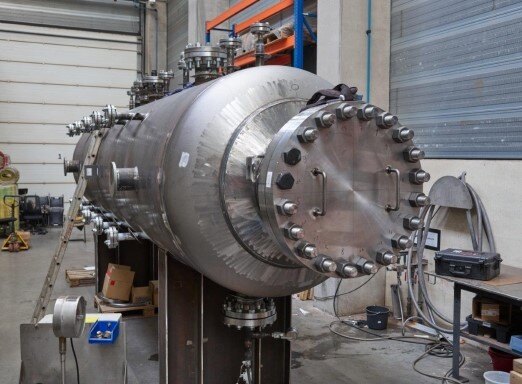
Pressure vessels are sealed equipment used in industrial production for storing or processing gases and liquids. They are widely used in industries such as petrochemicals, energy, pharmaceuticals, and others. Because these devices typically operate under high temperature and high pressure conditions, any failure may lead to serious accidents. Therefore, after manufacturing, or after modification and maintenance, a comprehensive evaluation of structural strength, sealing integrity, and reliability must be carried out.
Pressure testing is the core step of pressure vessel inspection, mainly including two methods: hydrostatic testing and pneumatic testing. This article will provide a detailed introduction to the operating procedures, applicable scenarios, safety requirements, and practical industrial precautions of these two tests, helping enterprises and technical personnel establish a systematic safety management awareness.
Hydrostatic testing (liquid pressure testing) is the most commonly used method in pressure vessel inspection. It involves injecting water into the system and pressurizing it to a specified pressure to check for leakage, deformation, or structural defects.
Because water is an incompressible medium, even if rupture occurs, it will not produce explosive impact. Therefore, its safety is much higher than pneumatic testing.
According to ASME VIII-1 UG-99, the hydrostatic test pressure for internal pressure vessels is calculated as:
Test Pressure = 1.3 × Maximum Allowable Working Pressure × (Material stress at test temperature / Material stress at design temperature)
This means the test pressure must reach at least 1.3 times the maximum allowable working pressure of the equipment, while also considering the influence of temperature on material properties. For carbon steel and low alloy steel vessels, the temperature of the test liquid shall not be lower than 15°C.
Before the test, the following preparations must be completed:
First, ensure all manufacturing and assembly work has been completed; then set vent openings at the top of the vessel. When filling the vessel, first fill it completely with liquid and remove all trapped air. When the vessel wall temperature approaches the liquid temperature, slowly increase the pressure to the design pressure. After confirming no leakage, continue increasing the pressure to the specified test pressure, and the holding time shall not be less than 30 minutes.
The acceptance criteria of the test are:
No leakage
No visible deformation
No abnormal sound during the test
For vessels made of high-strength materials, additional surface inspection is required to ensure no cracks are found.
Hydrostatic testing uses water as the medium, which is incompressible and stores very low energy, resulting in high safety. Even if failure occurs, problems can be detected before rupture, and no explosive shock wave is generated.
In addition, hydrostatic testing has the following advantages:
Water is widely available and low in cost, does not contaminate equipment (except where chloride corrosion needs consideration), temperature control is relatively easy, and drainage after testing is convenient without leaving harmful residues.
When hydrostatic testing cannot be performed, pneumatic testing can be used as an alternative method. According to ASME VIII-1 UG-100, pneumatic testing is applicable in the following cases:
Equipment cannot be filled with water or cannot be dried
Residual liquid is not acceptable (such as food-grade equipment or precision electronic components)
Vessel structure and support cannot withstand liquid weight
Internal coatings or linings may be damaged
Site conditions do not allow the use of water medium
Because gas is compressible and stores high energy, once failure occurs it may lead to explosion. Therefore, pneumatic testing is significantly more dangerous than hydrostatic testing. For this reason, standards impose stricter requirements:
The test pressure calculation formula is:
Test Pressure = 1.1 × Maximum Allowable Working Pressure × (Material stress at test temperature / Material stress at design temperature)
Before performing pneumatic testing, the following requirements must be met:
The gas used shall be dry and clean air, nitrogen, or other inert gas
For carbon steel and low alloy steel vessels, the gas temperature shall not be lower than 15°C
A pressure relief device must be installed, and its set pressure shall not exceed 1.1 times the test pressure
Welded joints must pass 100% non-destructive testing
Pneumatic testing must be approved in writing by the project manager and a larger safety exclusion zone must be established. During testing, personnel must avoid standing in the “blast direction,” and lighting, communication, and personal protective equipment must be fully ensured. Safety department personnel must be present on-site for supervision.
According to relevant standards, for vessels undergoing pneumatic testing, longitudinal and circumferential weld seams must undergo 100% radiographic or ultrasonic testing to ensure no internal defects exist.
The pressure increase must strictly follow the procedure below:
First increase pressure to 10% of the specified test pressure and not exceeding 0.05 MPa, hold for 5–10 minutes for initial leak inspection
If qualified, continue increasing to 50% of test pressure and observe for abnormalities
Increase step by step in 10% increments until reaching the specified test pressure, holding at each stage
After reaching test pressure, hold for 30 minutes
Finally reduce pressure to 87% of test pressure for full inspection
The tightness test is different from pneumatic testing. Pneumatic testing is a pressure strength test, while tightness testing is a sealing performance test, mainly used to detect micro penetrating defects.
Application Scenarios: When the medium in a pressure vessel is highly toxic or extremely hazardous, or when the design does not allow even minor leakage, a tightness test is required. This test must only be performed after hydrostatic testing is completed, and the test pressure is usually the design pressure.
Test Method: During testing, the pressure should rise slowly to the specified test pressure and be held for no less than 30 minutes. All weld seams and connections are checked by applying soap solution, and no leakage is allowed.
For small vessels, immersion in water may also be used to observe whether bubbles are generated.
In addition to post-manufacturing pressure testing, industrial practice also includes multiple types of pressure tests:
- Pre-commissioning leak test: used before startup or commissioning to check sealing performance and ensure no leakage risk before operation. This is typically carried out after installation and before formal operation.
- Re-validation test: used for in-service equipment integrity assessment to confirm that equipment still maintains sufficient strength and sealing performance after long-term operation. The inspection interval depends on equipment importance and media hazard level.
- Operational test: uses working medium under operating pressure to verify performance under actual conditions. This type of test is closer to real operating conditions and can reveal issues not considered during design.
- Strength test: verifies structural strength under design pressure to ensure the equipment can withstand normal operating loads. It is usually performed after modification or major repair.
- System test: pressurizes the entire pipeline and equipment system to check overall sealing and coordination. This can identify leakage at connections such as interfaces, valves, and flanges.
- Tightness test: confirms zero leakage, typically used in high sealing requirement applications such as toxic media, high-value products, or environmentally sensitive systems.
Pressure vessel inspection standards mainly include international standards and national standards:
ASME Boiler and Pressure Vessel Code (BPVC): ASME BPVC Section VIII specifies requirements for design, welding, heat treatment, and inspection. It is internationally recognized. Pressure vessels certified by ASME must meet standardized requirements in materials, design, manufacturing, and inspection.
API 510: developed by the American Petroleum Institute for in-service pressure vessel inspection, including internal and external inspection, thickness measurement, and corrosion monitoring, widely used in petrochemical industries.
BS EN 13445: European standard focusing on design and inspection of unfired pressure vessels, widely used in Europe.
China GB150 standard: The national standard “Pressure Vessel” provides detailed requirements for pressure testing and tightness testing, including test pressure, temperature, medium, procedure, and acceptance criteria.
Industrial pressure system inspection cycles are typically between 1 and 5 years, depending on equipment type, usage, and regulatory requirements. Differences between countries are significant:
- Singapore: steam boilers must be inspected annually
- United Kingdom: boilers typically inspected every 12 months, extendable to 24–26 months if in good condition
- Australia and New Zealand: first inspection after one year of service, then external inspection every 2 years and internal inspection every 4 years
- United States: external inspection every 5 years, internal inspection every 10 years or not exceeding half of remaining service life
Enterprises should develop reasonable inspection plans based on equipment importance, medium hazard level, and operating environment, and strictly implement them.
Pressure testing itself carries risks and must be controlled through strict measures.
A complete risk assessment must be conducted to identify hazards and define control measures. Operators must be qualified and trained, familiar with procedures and safety requirements. The test area must be restricted, with barriers, warning signs, and monitoring measures.
All tests must be carried out under a permit-to-work system with clearly defined responsibilities, supervision personnel, and emergency procedures. Calibrated pressure control equipment must be used, ensuring pressure gauges and safety valves are reliable.
Equipment must be continuously monitored during pressurization; unattended operation is strictly prohibited. Pressure increase must be slow, and rapid pressurization is forbidden. Once test pressure is reached, the pressurization system must be isolated or disconnected, and valves locked to prevent accidental overpressure.
Temperature changes causing fluid expansion must be considered, and adjacent system pressures must be monitored to avoid interference. Personnel must not approach equipment before pressure drops to a safe level. Tightening bolts or performing maintenance under pressure is strictly prohibited.
Operators must wear full personal protective equipment, including safety helmets, protective eyewear, safety shoes, and gloves. During pneumatic testing, personnel must avoid the “blast direction,” meaning the possible rupture direction of equipment. Adequate lighting and communication systems must be ensured for emergency response.
After testing, air must first be vented from high points, followed by drainage from low points to avoid vacuum formation and deformation. For pneumatic testing, pressure must be released slowly to prevent sudden impact. Discharged test media must comply with environmental protection requirements and must not be released arbitrarily.
In industrial practice, pressure testing accidents have occurred, providing valuable safety lessons:
- Case 1: Misuse of gas cylinder for pressurization leading to pressure runaway and fatal accident among maintenance personnel. This highlights the need for proper pressurization equipment with reliable control and safety valves.
- Case 2: Excessive test pressure in a storage tank causing the tank roof to rupture and fly off. This emphasizes strict control of test pressure and correct calculation.
- Case 3: Replacement of hydrostatic testing with pneumatic testing in a chemical plant leading to explosion and casualties. This shows the importance of selecting correct test medium and prioritizing hydrostatic testing when possible.
- Case 4: Incomplete air removal causing uneven pressure distribution and local failure. This demonstrates the necessity of complete venting before hydrostatic testing.
- Case 5: Failure of pressure control system resulting in overpressure explosion. This highlights the importance of safety devices such as pressure gauges and safety valves.
Common causes include violation of procedures, incorrect medium selection, pressure control failure, poor communication, and insufficient safety measures. Lessons learned emphasize using correct test media, strictly controlling pressure rise, ensuring safety valve functionality, and establishing clear operational procedures.
Pressure vessel pressure testing is a critical process for ensuring safe industrial operation, but it also involves significant risks. Hydrostatic testing is the preferred method due to its high safety and low cost, while pneumatic testing is only used in special conditions and requires stricter safety management.
Only by strictly following international standards, implementing standardized procedures, and strengthening safety awareness can accident risks be effectively reduced and industrial systems operate safely and reliably.
Enterprises should establish comprehensive testing systems, develop reasonable test plans based on equipment type, operating environment, and regulations, select appropriate testing methods, and ensure that all operators are properly qualified and trained.
Through strict implementation of pressure testing and timely maintenance, not only can catastrophic accidents be prevented, but equipment service life can also be extended, maintenance costs reduced, and safe production and economic benefits achieved simultaneously.
