Skid-mounted pressure vessel are complete systems in which pressure vessel and related auxiliary equipment are integrated and installed on a steel frame skid. Simply put, they function like a boxed system, all necessary components, including the pressure vessel body, piping, valves, instruments, pumps, filters, sensors, and so on, are pre-assembled in a sturdy framework in the factory, tested, and then transported to the site as a complete unit.
The core of this design approach lies in “factory prefabrication and system integration.” Traditional industrial equipment installation requires extensive on-site welding, assembly, and commissioning, whereas skid-mounted pressure vessel move these tasks into a controlled factory environment. Once the equipment arrives on site, it can be rapidly put into operation by simply connecting utilities such as water, electricity, and gas.
The typical composition includes: vertical or horizontal pressure vessel bodies, control panels and automation systems, various valves and pipe fittings, pumps, compressors or heat exchangers, as well as lifting lugs and forklift slots for handling and transportation. The entire system is compact in structure, occupies minimal space, yet retains full functionality.
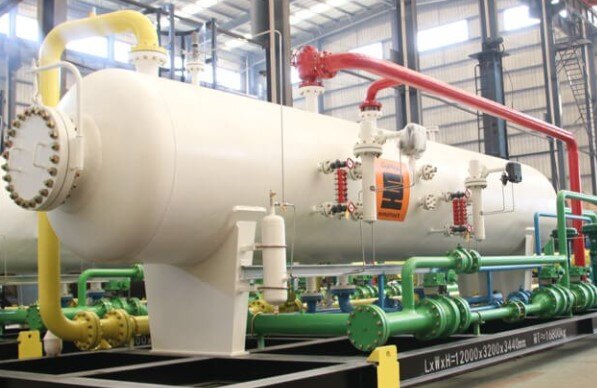
Skid-mounted pressure vessel have quickly gained popularity in numerous industrial fields because they address many of the pain points of traditional on-site construction. Compared with the traditional approach of dispersed procurement and on-site assembly, the factory prefabrication and overall delivery model brings revolutionary changes. Specifically, the advantages of skid-mounted pressure vessel include:
One of the greatest advantages of skid-mounted pressure vessel is the speed of installation. Because the system is pre-assembled and tested in the factory, only simple on-site connections are required, significantly reducing installation time. Traditional on-site construction requires coordination among multiple trades, while skid-mounted equipment achieves “plug-and-play,” making it especially suitable for projects requiring rapid commissioning.
This parallel manufacturing model means that while skid modules are assembled in the factory, on-site piping and cable installation can proceed simultaneously without interference. Once the skid module arrives on site, only final connections are required.
The skid-mounted design employs a compact layout that maximizes the use of available space, particularly suitable for retrofit projects or sites with limited space. By reducing on-site work, labor costs are significantly lowered. Additionally, factory prefabrication allows stricter quality control, reducing the frequency of rework and modifications, thereby further controlling total project cost.
Moreover, skid-mounted systems have a high equipment reuse rate. When relocation or modification is needed, the entire system can be moved as a whole, avoiding the high cost of dismantling and rebuilding traditional fixed installations.
The factory environment provides better welding conditions, more precise assembly, and more complete testing equipment. All manufacturing processes are completed under controlled conditions, ensuring material quality, validated welding procedures, and comprehensive non-destructive testing (such as X-ray inspections).
The design and manufacture of skid-mounted pressure vessel must comply with standards such as ASME Boiler & Pressure Vessel Code and national safety regulations for pressure vessel. These standards define design calculations, material selection, manufacturing processes, and inspection tests, ensuring safe operation under extreme conditions such as high pressure and high temperature.
The layout of skid-mounted systems is carefully designed, with sufficient maintenance access for daily servicing and troubleshooting. When production needs change or the facility needs relocation, skid-mounted equipment can be transported as a complete unit, providing flexible adaptation to different operational scenarios.
A complete skid-mounted pressure vessel system typically includes the following core components:
- Pressure Vessel Body: The core of the system, which may be a storage vessel, reactor, heat exchanger, or separator depending on process requirements. Materials are usually carbon steel, stainless steel, or special alloys to ensure pressure and corrosion resistance.
- Piping and Valve System: Piping connecting each piece of equipment is prefabricated in the factory and undergoes welding procedure qualification and non-destructive testing. Valves include gate valves, control valves, safety valves, etc., to control medium flow and relieve pressure.
- Instrumentation and Control System: Monitoring instruments such as pressure gauges, thermometers, and level meters track operational status in real-time. PLC control systems enable automation, and data acquisition systems record operational parameters.
- Pumps and Compressors: Used to transport liquid or gas media, selected according to process requirements, including centrifugal pumps, gear pumps, or various compressors.
- Steel Skid Frame: The base framework supports all equipment and considers transport load, lifting stress, operational weight, and seismic load during design.
- Safety Devices: Safety valves, rupture disks, and emergency shut-off valves ensure timely pressure relief or media isolation in abnormal conditions.
- Oil & Gas Industry: Skid-mounted pressure vessels are widely used in oil and gas exploration, production, and storage. Typical applications include gas-liquid separation systems (separating natural gas, water, and solids from crude oil), water injection pump skids, fuel regulation skids, and modular processing systems for offshore platforms and remote locations. Skid-mounted separators for well testing can be quickly installed at the wellhead, providing real-time monitoring to support production decisions. These systems are designed to withstand harsh conditions, including wind, seismic activity, and corrosion.
- Chemical Industry: Batch reactors, mixed process skids, catalyst regeneration systems, and temperature-controlled pressure units in chemical production commonly use skid-mounted designs. Chemical processes often involve high temperature and pressure, flammable or explosive media, and toxic substances, demanding high safety and reliability. Skid-mounted reaction units typically include agitators, condensers, receiving tanks, and vacuum systems, suitable for fine chemical and pharmaceutical intermediate production. This design enables rapid product changeover, supporting small-batch, multi-product operations.
- Water Treatment Industry: Skid-mounted systems are widely applied in reverse osmosis pre-treatment, chemical dosing, and pressurized filtration. They support water softening, filtration, sterilization, and desalination in industrial circulating water, boiler feedwater, and wastewater treatment. Their high degree of standardization allows flexible combinations based on treatment capacity and rapid deployment at different sites.
- Pharmaceutical and Biotechnology Industry: Pharmaceutical equipment requires strict cleanliness and validation. Skid-mounted systems include sterile mixing skids, CIP (clean-in-place) systems, and jacketed fermenters, complying with GMP standards. Typically made of 316L stainless steel with polished surfaces, they are easy to clean and sterilize. These systems can shorten validation time, helping projects with tight schedules obtain production licenses faster.
- Food and Beverage Industry: Applications include cooking and mixing skids, pasteurization systems, and syrup or seasoning dosing skids. Skid-mounted systems ensure food safety and production efficiency. Food-grade designs meet hygiene standards, comply with safety regulations, and allow routine cleaning and maintenance.
Designing a high-quality skid-mounted pressure vessel system requires consideration of:
- Site Layout Constraints: Determine skid size according to available site space, considering equipment spacing, operation aisles, and maintenance access. Retrofit projects may require customized designs based on existing plant conditions.
- Transport and Installation Requirements: Consider transport size restrictions (e.g., road width and height limits), lifting point placement, and center of gravity. Large skids may need modular construction for on-site assembly.
- Weight Distribution and Foundation Load: Calculate total operational weight and center of gravity to ensure skid frame strength and foundation load capacity. Finite element analysis may be performed if necessary.
- Thermal Expansion Management: High-temperature equipment generates thermal expansion; piping should include expansion joints or natural bends to avoid thermal stress damage.
- Automation and Monitoring: Determine automation level based on process complexity; simple systems may only require local instruments, while complex processes need PLC control and SCADA monitoring for remote operation and data recording.
- Regulatory and Standards Compliance: Ensure design complies with ASME VIII, GB150, and industry-specific standards such as NACE. Exported equipment must meet target market certification requirements.
The manufacturing of skid-mounted pressure vessel is a systematic engineering process including:
- Design Stage: Process and mechanical design based on customer requirements, including strength calculation, stress analysis, piping layout, and electrical design; generate construction drawings and material lists.
- Material Procurement: Select high-quality, code-compliant materials such as pressure vessel steel plates, pipes, and forgings. Material certificates must be provided, and critical materials undergo chemical and mechanical verification.
- Prefabrication: Cutting, rolling, welding, and machining in the factory. Welding must be performed by certified welders according to qualified procedures; only after passing NDT inspections can welding proceed to the next stage.
- Heat Treatment: For thick-walled vessel or special requirements, post-weld heat treatment eliminates residual stress and improves material performance.
- Assembly and Integration: Install pressure vessel, pumps, valves, and instruments on the steel skid, connecting piping and electrical wiring to form a complete system.
- Factory Testing: Conduct pressure tests (e.g., hydrostatic), leak tests, and functional tests to verify sealing and operational performance. Control systems undergo simulated operation testing.
- Surface Treatment: Rust removal, painting, or passivation for stainless steel to protect against corrosion.
- Packaging and Shipping: Choose appropriate packaging based on transport method, with anti-corrosion, shock-proof, and waterproof measures, and prepare packing lists and user manuals.
When selecting a skid-mounted pressure vessel, companies should focus on:
- Supplier Qualifications: Choose a manufacturer with pressure vessel production licenses (e.g., ASME U stamp, A1/A2 license) to ensure design and manufacturing capabilities meet standards.
- Project Experience: Evaluate supplier experience in relevant industries, especially with similar process conditions.
- Quality Control System: Examine the supplier’s quality management system, including raw material control, process inspection, and final testing.
- After-Sales Service: Confirm the supplier can provide installation guidance, commissioning support, spare parts, and maintenance services.
- Customization Capability: Suppliers should be able to provide custom designs for unique industrial project requirements.
Skid-mounted pressure vessel represent a major transformation in industrial equipment deployment. Through factory prefabrication and system integration, these systems achieve rapid installation, cost savings, controlled quality, and flexible relocation.
Whether in oil and gas, chemical, water treatment, pharmaceutical, or food industries, skid-mounted pressure vessel help users improve construction efficiency and reduce operational risks. For projects requiring rapid commissioning, limited space, or frequent relocation, skid-mounted pressure vessel are an excellent solution.
With continued technological advancements and accumulated application experience, skid-mounted pressure vessel will play an increasingly important role across industrial sectors and become a standard in modern industrial infrastructure.
