Storage tank venting systems are fundamental safety components in industries such as oil, gas, chemicals, and pharmaceuticals. These systems are designed to maintain the integrity of storage tanks by allowing them to breathe, releasing gas when internal pressure rises and admitting air or inert gas when a vacuum forms. This continuous balancing of internal pressure protects the tank structure and ensures safe operation. Without an effective venting system, a storage tank behaves like a sealed can. When the liquid is filled or the temperature rises, internal pressure can increase rapidly; conversely, cooling or liquid withdrawal can create a vacuum. Both scenarios can lead to deformation, rupture, or even catastrophic explosions. By automatically regulating pressure, venting systems prevent such dangers, safeguarding both personnel and the surrounding environment.
Storage tanks are not static containers. They are dynamic pressure vessels subject to continuous fluctuations in internal conditions. Two primary factors contribute to these changes: thermal effects and liquid movement.
Daily temperature variations cause the liquid and vapor inside the tank to expand or contract. During the day, solar radiation raises the tank’s temperature, causing the liquid and vapor to expand and internal pressure to increase. To relieve this pressure, the tank must "exhale," allowing gas to escape safely. At night, as temperatures drop, vapors contract, creating a vacuum. The tank then "inhales" air or inert gas to prevent structural collapse.
This cycle occurs repeatedly every day. Without proper management, it can cause cumulative structural damage over time. The repeated stress may lead to warping, weakened welds, or even cracks in the tank shell. Over extended periods, such stress can compromise the tank’s operational lifespan.
Filling and emptying tanks also cause pressure fluctuations. When liquid is introduced, it displaces the vapor in the headspace, which must escape to avoid overpressure. When liquid is withdrawn, a cavity forms, creating a vacuum that must be filled by air or inert gas.
If this venting process is obstructed, filling the tank may cause internal pressure to exceed safe limits, potentially rupturing the tank. Conversely, vacuum formation during emptying can lead to implosion or inward deformation.
For tanks storing harmless liquids such as water, simple open vents may suffice. However, tanks storing thousands of liters of benzene, methanol, crude oil, or other volatile chemicals face far greater risks. Uncontrolled vapor release not only violates environmental regulations but also creates flammable vapor clouds, posing severe fire and explosion hazards.
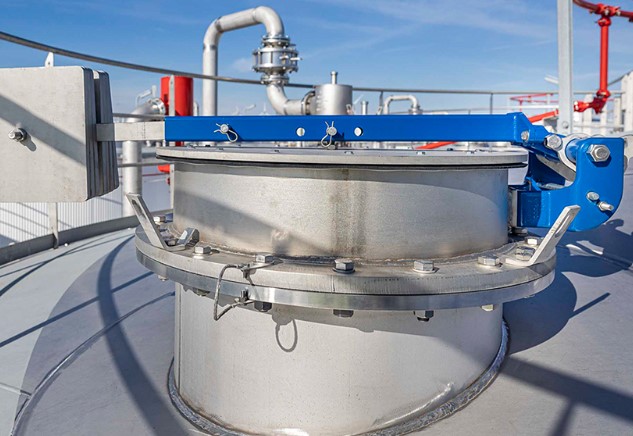
A modern venting system consists of several specialized components, each designed to perform a specific safety function. Together, they maintain safe tank operation under both normal and emergency conditions.
The pressure-vacuum relief valve is the first line of defense and the primary daily protection device. Unlike simple open vents, a PVRV remains closed until the tank reaches pre-set pressure or vacuum limits.
- Operation: When internal pressure rises to the set point (typically around 90% of the tank’s maximum allowable working pressure, MAWP), the valve opens, releasing sufficient vapor to prevent overexpansion. Once pressure normalizes, the valve closes automatically to minimize product loss and emissions. When the tank cools or liquid withdrawal creates a vacuum, the valve opens in reverse, admitting air or inert gas to prevent tank collapse.
- Advantages: Reduces product evaporation loss; Lowers flammable vapor concentration near the tank roof; Ensures operation within safe pressure limits; Provides reliable, automated pressure regulation without manual intervention.
For tanks storing flammable liquids, flame arrestors are essential safety devices. Installed in vent lines, they are passive protection components designed to stop flames from traveling back into the tank.
- Operation: Internally, flame arrestors consist of coiled or meshed metal elements forming narrow channels. Gas flows freely during normal operation. If a flame attempts to travel back along the vent line, the metal absorbs heat from the flame front, extinguishing it before it can reach the vapor space.
- Applications: Required for tanks storing low-flashpoint liquids such as gasoline, acetone, and crude oil. Prevents external ignition sources from causing catastrophic explosions inside the tank.
Emergency pressure relief devices serve as the final safeguard during extreme events. Regular breather valves manage day-to-day pressure fluctuations, but rapid vapor generation during fires or other emergencies can exceed their capacity.
- Operation: Typically designed as large, weighted lids installed at the tank top. These lids remain closed under normal conditions. When internal pressure reaches a critical threshold (slightly below the tank rupture point), the lid opens rapidly, releasing a large volume of vapor to prevent structural failure.
- Importance: Although rarely activated, emergency relief valves are critical for protecting personnel and adjacent facilities during extreme events, preventing catastrophic accidents.
Service vents are fundamental components for handling routine pressure fluctuations caused by temperature changes or liquid level variations. They prevent destructive overpressure or vacuum formation during normal tank operation.
Certain chemicals are highly volatile or sensitive to oxygen. Direct air intake can degrade product quality or create flammable mixtures. Nitrogen blanketing replaces air with inert nitrogen gas, forming a protective layer above the liquid.
Benefits: Prevents oxygen exposure and combustion reactions. Blocks moisture and contaminants. Maintains product quality and stability.
Despite advances in tank safety, some industries still use gooseneck (open) vents. These bent pipes were originally intended to let tanks breathe while keeping rain and dust out. Modern safety standards, however, consider goosenecks both inadequate and unsafe due to several reasons:
- Lack of Pressure Control: Vapors escape freely, causing continuous product loss.
- Environmental Pollution: Uncontrolled VOC emissions violate modern environmental regulations.
- Fire and Explosion Hazards: Open vents create persistent vapor clouds, which can ignite from any spark. Backflash into the tank is also possible.
- Hidden Costs: Although initial investment is low, potential accident recovery, fines, and environmental liabilities far exceed savings.
In comparison, pressure relief valves provide controlled venting, minimize losses, and comply with regulations, making them essential for safe tank operation.
Designing an effective venting system requires precise calculations and engineering judgment. Key parameters include:
- Flow Rate: The system must handle maximum fill or discharge rates and vapor generation. Insufficient flow capacity can prevent valves from responding in time, leading to overpressure or vacuum events.
- Pressure Settings: Relief valves must be calibrated according to the tank’s MAWP, typically at ~90% to provide safety margin without frequent cycling.
- Backpressure: Downstream pipe resistance affects vent performance; excessive backpressure can impede valve operation.
- Standards Compliance: API 2000 provides detailed guidelines for atmospheric and low-pressure tank venting, including calculation formulas for different scenarios.
- Environmental Considerations: Site location, climate, and liquid volatility must be factored into vent sizing. Even minor deviations can lead to severe consequences under extreme conditions.
Maintenance valves are crucial components that prevent overpressure or vacuum accumulation by releasing excess pressure safely.
Steps for Designing an Efficient Venting System:
- Identify Tank Information: Determine type, structure, capacity, stored medium, and environmental conditions.
- Analyze Hazards: Identify potential causes of overpressure or vacuum, including temperature fluctuations, fill/empty operations, chemical reactions, and mechanical failures.
- Select Appropriate Valves: Match valve capacity to tank size and expected pressure/vacuum conditions. Undersized valves cannot protect the tank, while oversized valves reduce efficiency and increase costs.
- Installation and Maintenance: Proper installation, regular testing, and preventive maintenance ensure reliable operation and compliance with safety regulations.
- Petroleum Tanks: Handle large volumes of volatile vapors. PVRVs combined with flame arrestors are standard; large tanks require emergency relief.
- Chemical Tanks: Diverse chemicals require specific strategies. Corrosive liquids need specialized valve materials. Highly volatile solvents may require nitrogen blanketing. Oxygen-sensitive products require closed inert gas systems.
- Pharmaceutical Tanks: High-quality standards necessitate contamination prevention. Nitrogen blanketing is commonly used for active pharmaceutical ingredients (APIs). Venting valves must meet sanitary standards.
- Natural Gas Tanks (LNG): Operate under extreme cold. Venting systems must handle boil-off gas (BOG) effectively while functioning reliably in sub-zero conditions.
Venting systems are heavily regulated to ensure environmental and operational safety. Major requirements include:
- Environmental: Limit VOC emissions; open vents are often banned or strictly restricted.
- Safety Standards: API 2000, NFPA, and similar codes specify design, installation, and maintenance criteria.
- Occupational Health: Protect operators from exposure to harmful vapors.
- Inspection and Testing: Regular calibration, cleaning of flame arrestors, and testing of relief valves ensure reliability during critical events.
Although storage tank venting systems may appear simple, they are a critical component of industrial safety. From routine pressure management to emergency protection, and from preventing product loss to safeguarding the environment, they serve multiple essential functions.
For hazardous material tanks, PVRVs, flame arrestors, and emergency relief valves form a vital safety barrier. Proper selection, chemical compatibility, and routine maintenance are essential to maintain system effectiveness. Replacing outdated open vents with modern, pressure-controlled systems is not only regulatory compliance—it is a fundamental measure to protect both assets and personnel. Ultimately, the quality of vent system design and maintenance can determine whether a catastrophic incident occurs.
