

- Oct 25, 2026
- Hits: 1
How much does it cost to install an air receiver tank, and what does the installation price actually include? The total cost depends on the tank's classification, capacity, working pressure, installation location, piping requirements, safety accessories, labor, and regulatory compliance obligations. A simple pressure vessel may require a relatively straightforward installation, while a stationary pressure vessel subject to additional regulatory procedures can involve qualified contractors, inspection arrangements, technical documentation, and more extensive commissioning work.
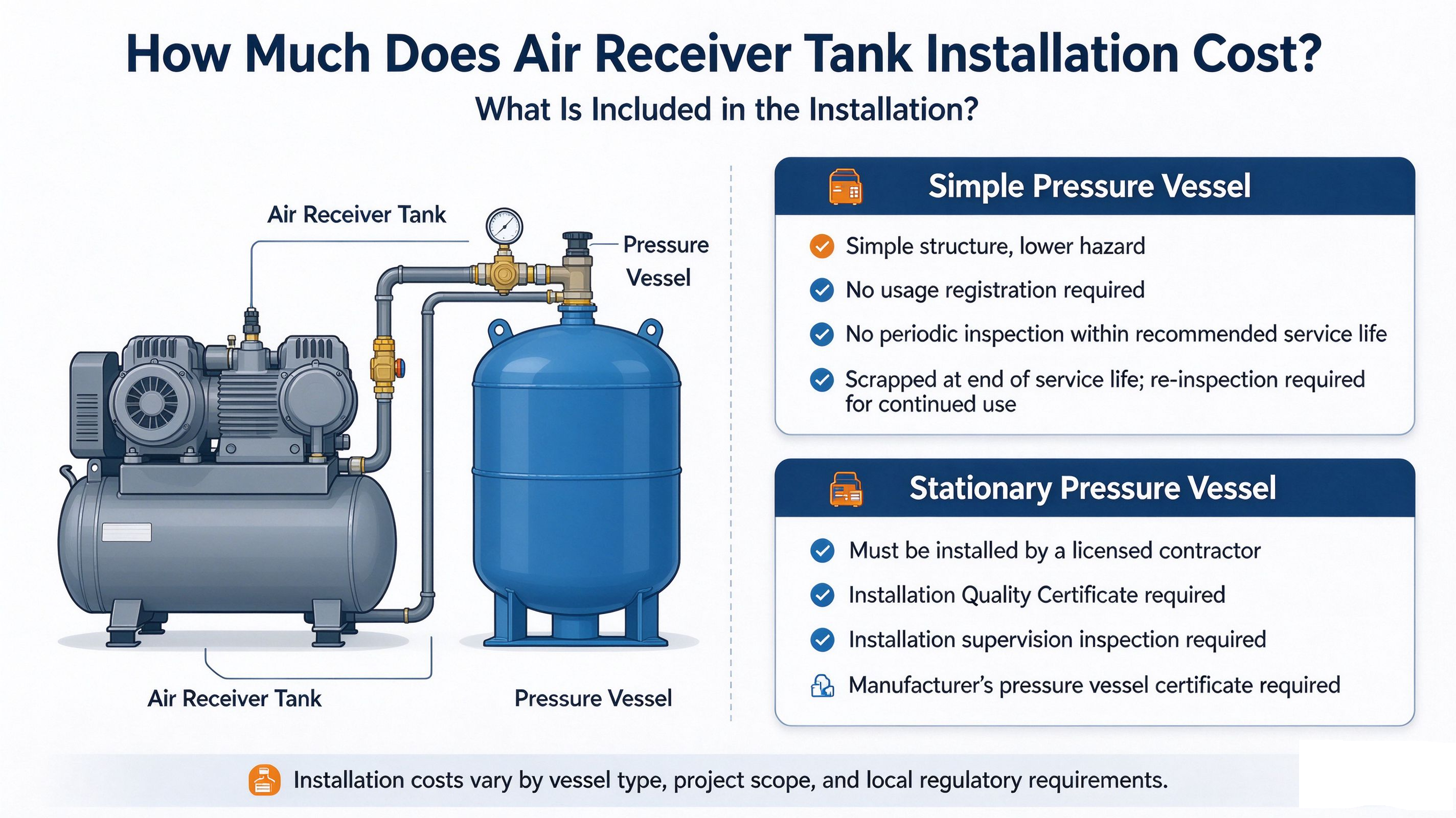
An air receiver tank is a pressure vessel installed in a compressed air system to store compressed air temporarily and help stabilize system pressure. It is commonly used with industrial air compressors in manufacturing plants, workshops, automotive facilities, food processing operations, and other applications requiring a reliable supply of compressed air.
Although an air receiver may look like a relatively simple steel tank, it performs several important functions in a compressed air installation. It provides a buffer between compressor output and fluctuating downstream demand, reduces rapid pressure changes, and can help reduce unnecessary compressor cycling when the system is designed appropriately. When installed upstream of suitable moisture separation equipment, it may also support cooling and condensation of water vapor, although effective condensate removal still requires appropriate drains and downstream air treatment.
The installation cost should therefore be evaluated as part of the complete compressed air system rather than as a standalone tank-placement expense.
An air receiver tank typically provides the following benefits:
- Pressure stabilization: The tank provides a temporary reservoir that helps reduce pressure fluctuations caused by intermittent air demand.
- Peak-demand support: Stored compressed air can help meet short-duration demand peaks that exceed the compressor's immediate output.
- Reduced compressor cycling: In systems with suitable controls, sufficient receiver volume can reduce excessively frequent compressor starts and stops.
- Moisture management: Cooling compressed air can promote condensation, which can then be removed through suitable drains and separators.
- Operational flexibility: The receiver provides a buffer that can improve the response of the compressed air system to changing demand.
However, an air receiver does not automatically improve energy efficiency in every installation. Its performance depends on receiver sizing, compressor control strategy, pressure settings, air demand patterns, and the configuration of downstream equipment.
There is no single installation price that applies to every air receiver tank. Two tanks with similar capacities may have significantly different installation costs because their pressure-vessel classifications, site conditions, piping arrangements, and compliance requirements differ.
The total project cost can be divided into several major categories.
| Cost category | Typical scope | Main cost drivers |
|---|---|---|
| Tank and accessories | Receiver vessel, nameplate, specified fittings | Capacity, pressure rating, material, manufacturer |
| Transport and handling | Delivery, unloading, lifting, positioning | Weight, dimensions, access, lifting equipment |
| Mechanical installation | Positioning, anchoring, leveling, supports | Site layout, foundation, mounting requirements |
| Compressed air piping | Pipework, fittings, valves, connections | Pipe size, material, routing, installation complexity |
| Safety accessories | Pressure gauge, safety valve, drain equipment | Design requirements, specifications, certification |
| Electrical and controls | Sensors, alarms, control wiring, if required | Automation level, integration requirements |
| Inspection and documentation | Applicable inspection, verification, technical records | Vessel classification and local regulatory requirements |
| Commissioning | Leak checks, functional tests, handover | Testing scope, labor, commissioning requirements |
Not every project requires every item listed above. Some manufacturers supply a complete package with the required accessories, while other installations require the buyer or contractor to purchase and install these items separately.
The most reliable way to compare quotations is to identify exactly which costs are included and which are excluded.
In China, the regulatory classification of an air receiver can have a substantial effect on installation arrangements and associated costs. The source material distinguishes between simple pressure vessels and stationary pressure vessels. These categories should not be treated as interchangeable, and the classification must be verified against the applicable Chinese special-equipment safety technical specifications.
A vessel's appearance or nominal capacity alone is not sufficient to establish its legal classification. Relevant factors may include the medium, design pressure, volume, temperature, structure, intended use, and the definitions and exclusions contained in the applicable regulations.
A simple pressure vessel is a specifically defined regulatory category, not simply any small or uncomplicated tank. Certain qualifying air receivers may fall within this category if they meet the relevant requirements.
Compared with pressure vessels subject to more extensive regulatory procedures, qualifying simple pressure vessels may have a more straightforward use-management process. Depending on the applicable rules, they may not require the same use-registration or periodic-inspection arrangements that apply to other regulated vessels.
This does not mean that a simple pressure vessel can be installed without safety checks. The equipment must still be suitable for its intended service, installed according to the manufacturer's instructions, and operated within its rated pressure and temperature limits.
Installation costs for a qualifying simple pressure vessel may include:
- Delivery and unloading.
- Positioning and leveling.
- Foundation or support preparation, where required.
- Connection to the compressed air piping system.
- Installation or verification of required safety accessories.
- Condensate drain installation.
- Leak checks and commissioning.
- Handover of the manufacturer's documentation and operating instructions.
Where the tank can be installed in an accessible location with short pipe runs and no substantial site modifications, the work may be relatively straightforward. However, lifting requirements, restricted access, corrosion protection, drainage arrangements, and the need to modify existing piping can still increase the total cost.
The source material also notes that simple pressure vessels have a recommended service life. The applicable product documentation and current regulations should be consulted to establish what is required when that service life is reached. Continued use should never be assumed to be permissible solely because the tank appears to be in good condition.
Stationary pressure vessels that fall within the applicable regulatory scope can involve additional installation and use-management requirements. The work may require a contractor with the appropriate qualifications, installation quality records, inspection arrangements, and supporting product documentation.
Depending on the vessel, installation method, and applicable rules, the project may need to address:
- Verification of the pressure vessel's design and product documentation.
- Confirmation that the installation organization has the required qualifications.
- Review of the installation method and quality-control arrangements.
- Inspection or supervision requirements where applicable.
- Verification of safety accessories and associated piping.
- Completion of required installation and inspection records.
- Use registration or other formalities where required by the applicable rules.
These requirements can increase the project cost because qualified personnel, documented quality procedures, inspection coordination, and additional administrative work may be necessary.
It is important not to assume that every stationary pressure vessel requires precisely the same set of certificates or procedures. The applicable obligations depend on the vessel's regulatory status and the specific installation. Before requesting quotations, the owner should confirm the current requirements with the competent local market-regulation authority or an appropriately qualified special-equipment professional.
| Consideration | Qualifying simple pressure vessel | Stationary pressure vessel subject to additional regulation |
|---|---|---|
| Installation complexity | Often relatively straightforward | May require more extensive planning and quality control |
| Contractor requirements | Depend on the applicable installation scope and rules | Appropriate qualifications may be required |
| Inspection arrangements | May be simpler under the applicable rules | Additional inspection or supervision may apply |
| Documentation | Manufacturer documentation and installation records | May require additional installation and inspection records |
| Use registration | May be exempt where the rules provide an exemption | May be required, depending on classification and applicable rules |
| Cost structure | Often concentrated on equipment, transport, piping, and labor | May also include qualified installation, inspection, and compliance costs |
This comparison is intended as a planning guide, not a substitute for a formal regulatory classification. The legal requirements should be confirmed before the project budget is finalized.
Transportation costs depend on the receiver's dimensions, weight, delivery distance, access conditions, and whether special handling equipment is needed. A small receiver may be delivered and moved using ordinary material-handling equipment, while a large vertical receiver may require a forklift, crane, or other lifting arrangement.
The quotation should clarify whether delivery includes unloading and movement to the final installation position. Transport to the site and movement within the factory are separate activities in some contracts.
Restricted entrances, narrow corridors, limited overhead clearance, and operating production areas can increase handling time. If the tank must be moved through a busy plant, the contractor may also need to coordinate work permits, temporary access restrictions, or an approved lifting plan.
The tank must be supported according to its design and installation instructions. Depending on the model, it may stand vertically on legs, rest on a designed support structure, or use another approved mounting arrangement.
Installation work can include checking the floor or foundation, leveling the tank, installing support pads, and fitting anchors where required. The support system must account for the equipment's weight, operating conditions, and applicable structural requirements.
A tank that is incorrectly supported may experience unwanted loads on its shell, connections, or connected piping. Anchoring requirements should be determined from the manufacturer's instructions and the site design rather than by applying an arbitrary fixing method.
For a new factory installation, foundation work may be included in a broader construction contract. For a retrofit project, the contractor may need to repair the floor or modify the support arrangement, adding cost beyond ordinary mechanical installation.
Connecting the receiver to the compressor and downstream distribution network is often a significant part of installation work. The scope may include pipe sections, fittings, isolation valves, flexible connections where appropriate, supports, and connection to existing headers.
Piping costs depend on:
- Pipe diameter and material.
- Operating pressure and temperature.
- Total pipe length and routing complexity.
- Number of bends, tees, reducers, and isolation points.
- Whether existing piping can be reused.
- Required supports and corrosion protection.
- Access for installation and future maintenance.
The piping must be suitable for the compressed air service and the design pressure. A receiver should not be installed with improvised connections or piping that introduces excessive mechanical loads on its nozzles.
The contractor should also verify that the arrangement allows the receiver to be isolated safely for maintenance and that the system layout supports effective drainage and inspection.
Safety accessories are essential to the safe operation of an air receiver. Depending on the design and applicable requirements, the system may include a pressure gauge, safety relief valve, drain equipment, and other specified devices.
The safety relief valve must be appropriate for the vessel's pressure rating and required relieving capacity. Its selection should not be based solely on matching the nominal pipe connection. A relief device that is incorrectly sized, unsuitable for the service, or improperly installed may fail to provide the intended protection.
The pressure gauge should have a suitable range and accuracy for the operating conditions. The condensate drain should be accessible and suitable for the expected condensate volume and discharge conditions. Automatic drains may reduce manual intervention, but they introduce their own installation, maintenance, and potential failure considerations.
Before purchasing accessories separately, check the receiver's supply scope. Some tanks are delivered with required accessories already installed, while others are supplied with only selected fittings or connections.
Basic air receiver installations may require little or no electrical work beyond existing compressor controls. More complex systems may use pressure transmitters, level or drain alarms, automatic drain controls, monitoring systems, or integration with a plant control system.
Electrical and instrumentation costs depend on the number of devices, cable routing, control-panel modifications, communication requirements, and the commissioning scope.
If the receiver is installed as part of a variable-speed compressor system or a centralized compressed air station, the controls may need to coordinate compressor loading and unloading, receiver pressure, and downstream demand. This integration should be planned so that pressure control remains stable and the compressor does not operate inefficiently because of conflicting set points.
Inspection and documentation costs vary with the regulatory classification and project scope. For some installations, the primary requirements may involve manufacturer documents, installation checks, and commissioning records. Other projects may require additional qualified personnel, inspection coordination, or formal documentation before the equipment can be placed into service.
The project team should establish the applicable requirements before installation begins. This helps avoid delays caused by missing documents or by discovering late in the project that a particular contractor qualification or inspection step is necessary.
For a regulated stationary pressure vessel, documentation may include the pressure vessel product certificate, installation quality records, inspection records where required, and relevant operating information. The exact document names and acceptance process should be confirmed with the responsible authority and the relevant inspection organization.
Commissioning confirms that the installed receiver and its associated components are ready for operation under the specified conditions. Depending on the project, the work may include checking connections, verifying accessory installation, reviewing pressure indications, checking for leakage, testing drains, and confirming the operating procedure.
Commissioning should also confirm that the receiver's pressure rating is compatible with the compressor and the rest of the system. If a pressure-reducing arrangement is used, the relationship between the receiver, compressor control settings, and downstream pressure requirements should be reviewed.
The handover package should identify the equipment, record relevant test results, provide operating instructions, and explain maintenance requirements. For regulated equipment, any additional required documentation should be completed before the tank is put into service.
A useful budget separates equipment costs from site work and compliance-related costs. This allows buyers to compare different suppliers and identify whether a low quotation excludes necessary work.
A basic cost model is:
Total installation cost = equipment and accessories + transportation and handling + foundation and mechanical work + piping + electrical and controls + inspection and documentation + commissioning.
This formula is a planning framework rather than a fixed pricing schedule. Some items may already be included in the tank purchase price or a turnkey installation contract.
The following table illustrates how a project manager can organize quotations. It intentionally does not assign unsupported market prices because labor rates, regional requirements, tank specifications, and installation conditions vary considerably.
| Budget item | Questions to ask the supplier |
|---|---|
| Receiver tank | What are the capacity, working pressure, material, and regulatory classification? |
| Delivery | Is transportation included? Does the price cover unloading? |
| Lifting and positioning | Is a crane or forklift required, and who supplies it? |
| Foundation and anchoring | Is the existing floor suitable? Are modifications included? |
| Piping | What pipe material, diameter, length, and fittings are included? |
| Safety accessories | Are the specified relief valve, gauge, and drain included? |
| Electrical work | Are sensors, cabling, control changes, and testing included? |
| Inspection and documentation | Which statutory or project-specific requirements apply? |
| Commissioning | What tests, records, and handover services are included? |
| Exclusions | Are taxes, permits, shutdown work, or civil modifications excluded? |
To obtain a meaningful cost estimate, provide the same technical information to every bidder. Comparing quotations with different scopes can produce misleading conclusions about which supplier is actually more economical.
Larger tanks generally require more handling capacity and may involve heavier supports, larger connections, and more demanding lifting arrangements. Higher design pressures can also affect vessel construction, accessories, and the applicable engineering requirements.
However, capacity alone does not determine installation cost. A large tank installed beside a compressor room with clear access may be easier to install than a smaller tank that must be moved through a restricted building or connected to a complex existing network.
Indoor installations may have restricted access, limited lifting clearance, and tighter working-space requirements. Outdoor installations may offer easier crane access but can require weather-resistant materials, suitable foundations, drainage provisions, and protection against environmental exposure.
Outdoor equipment may also need additional corrosion protection depending on the atmosphere and the nature of condensate or other contaminants. These requirements should be considered during equipment selection and budget preparation.
A new compressed air station can often incorporate the receiver into the original piping and control design. A retrofit installation may require temporary shutdowns, removal of existing pipework, rerouting of services, or changes to the compressor control strategy.
If the factory must remain operational during the work, installation may need to be carried out during planned shutdown windows or outside normal production hours. These constraints can increase labor and coordination costs.
Where the applicable rules require a qualified installation organization or additional inspection arrangements, the project budget must include those services. The owner should verify that the contractor's qualifications cover the specific work being performed.
It is also important to distinguish between the installation of the pressure vessel itself and the installation of associated pressure piping. The applicable requirements may differ depending on the piping's classification, service, and regulatory scope. The project should be assessed as a complete system rather than assuming that the tank's classification automatically determines every requirement for the connected pipework.
For projects in China, the relevant requirements should be established using the current special-equipment safety technical specifications, applicable national standards, and local regulatory procedures.
GB/T 150 is an important series of Chinese national standards for pressure vessels. The official national standards database lists GB/T 150.1-2024, Pressure Vessels—Part 1: General Requirements, as effective from February 1, 2025. GB/T 150.4-2024, covering fabrication, inspection, testing, and acceptance, also took effect on that date. These standards provide important technical context for pressure-vessel design and manufacture, but they do not by themselves replace the need to determine the equipment's regulatory classification and applicable installation requirements.
The State Administration for Market Regulation has also published implementation guidance concerning the stationary pressure vessel safety technical supervision regulation, TSG 21-2016. Because regulatory requirements and implementation arrangements can change, owners should verify the currently applicable version and any subsequent amendments before starting an installation.
A practical pre-installation compliance review should answer the following questions:
- What is the vessel's formal regulatory classification?
- Does the applicable regulation require installation by a qualified organization?
- Is installation notification, inspection, or supervision required for this particular project?
- Is use registration required, or does a specific exemption apply?
- Which product certificates and installation records must be retained?
- What inspection and maintenance requirements apply during service?
- Are the associated pressure piping and safety accessories subject to additional requirements?
These questions should be resolved before the contractor starts work. Doing so reduces the risk of unexpected inspection costs, missing documents, or delays in commissioning.
The most effective cost-saving strategy is to reduce unnecessary construction and coordination work while retaining all required safety and compliance measures.
Choose a receiver based on actual compressed air demand, compressor output, control strategy, working pressure, and required air quality. An unnecessarily large tank may increase purchase, transport, and installation costs, while an undersized tank may fail to provide the required buffer.
The tank's pressure rating and regulatory classification should be confirmed at the quotation stage. Changing the selected model after the site work has been planned can lead to additional engineering, piping modifications, and handling costs.
Ask the manufacturer or supplier to identify which accessories, fittings, certificates, and installation services are included. A slightly higher equipment price may be more economical if it includes the required components and documentation that would otherwise have to be purchased separately.
A clearly defined scope also helps prevent disputes between the tank supplier, installation contractor, and commissioning team.
Confirm access routes, floor conditions, lifting requirements, connection locations, and the availability of suitable utilities before the tank arrives. Where possible, coordinate the tank installation with other planned maintenance or construction work.
Site preparation can reduce idle labor, repeated equipment mobilization, and delays caused by restricted access or incomplete foundations.
When comparing suppliers, use the same technical specification and require each bidder to state exclusions explicitly. The lowest initial price may not represent the lowest total project cost if essential piping, accessories, testing, or documentation are excluded.
A useful comparison should consider not only the installation price but also the quality of the equipment, the clarity of the documentation, the availability of spare parts, and the maintenance support offered.
Where existing infrastructure is suitable, reusing properly assessed piping routes, supports, and connection points may reduce labor and material costs. However, any reuse must be based on technical compatibility and the applicable safety requirements, not simply on the desire to avoid new work.
Pressure-rated components, safety devices, and required inspection arrangements should never be omitted to achieve a lower initial quotation.
Several mistakes can create avoidable costs or compromise the safety of a compressed air system.
- Assuming every air receiver has the same regulatory status: Classification must be confirmed against the applicable rules.
- Selecting the tank based only on capacity: Working pressure, air demand, materials, and system layout also matter.
- Ignoring the cost of safety accessories: Required devices and their installation should be included in the budget from the beginning.
- Leaving documentation until the end: Missing certificates or inspection records can delay acceptance or commissioning.
- Using unsuitable supports or piping connections: Incorrect installation can impose unwanted loads on the vessel and its nozzles.
- Failing to plan condensate drainage: Poor drainage can lead to operational problems and accelerate corrosion.
- Comparing quotations with different scopes: An apparently cheaper offer may exclude important work.
- Assuming the tank can operate above its rated pressure: The compressor control settings and protective devices must be compatible with the vessel's permitted operating conditions.
These issues are best addressed through a pre-installation technical review and a clearly documented division of responsibilities among the owner, equipment supplier, installation contractor, and inspection organization.
No. The applicable process depends on the vessel's classification and the current regulations. Some qualifying simple pressure vessels may be exempt from certain use-management or inspection procedures, while other stationary pressure vessels may be subject to additional requirements. The classification should be confirmed before installation.
Not necessarily. Some manufacturers supply the tank with specified accessories, while others quote them separately. The buyer should confirm the supply scope, including the type and specifications of each required accessory, before placing the order.
Differences in site access, transport, lifting requirements, piping length, foundation work, contractor qualifications, inspection arrangements, and documentation can produce substantial cost differences even when the tank capacities are similar.
The regulatory requirements for a qualifying simple pressure vessel may be less extensive than those for some other pressure vessels, but safe installation still requires suitable technical knowledge. The work must follow the manufacturer's instructions and applicable safety requirements, and the connected system must be designed and installed appropriately.
At a minimum, request the documents applicable to the particular vessel, such as its product identification and certificate, nameplate information, operating instructions, and accessory documentation. Additional installation quality, inspection, or registration records may be required depending on the vessel classification and the installation circumstances.
The installation cost of an air receiver tank depends on much more than the tank's purchase price. Equipment specifications, transportation, lifting, foundation work, compressed air piping, safety accessories, commissioning, and regulatory compliance all contribute to the total project budget.
The distinction between a qualifying simple pressure vessel and a stationary pressure vessel subject to additional regulatory requirements is especially important in China. The former may have a more straightforward installation and use-management process, while the latter may require appropriately qualified contractors, additional quality records, inspection arrangements, and formal documentation.
For an accurate quotation, buyers should confirm the vessel's classification, define the complete installation scope, verify the required safety accessories, and check the applicable regulations before work begins. A properly planned installation helps control costs while maintaining the pressure-vessel safety, reliability, and documentation needed for long-term operation.