Multimedia filters are widely used pretreatment devices in water treatment systems. Through a combination of different filter media such as quartz sand, anthracite coal, and manganese sand, they effectively remove suspended solids, colloidal particles, and impurities from water. However, in actual operation, media loss in multimedia filter is a common problem. It not only affects filtration efficiency but also increases operational costs and can even damage downstream equipment. This article systematically analyzes various causes of media loss and provides practical preventive measures.
Backwashing is a key operation to restore the filtration capacity of the media. By reversing water flow, it removes impurities trapped in the media pores. However, during backwashing, the media is suspended and agitated; collisions between particles and water flow impact can produce wear. This is the main cause of media loss.
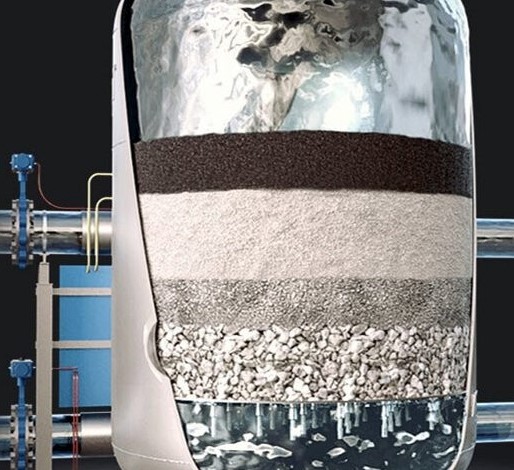
During backwashing, the media needs to be in a moderately expanded state, typically 10% to 20% of the original filter bed height. In this state, media particles collide and rub against each other under the action of water flow. This mechanical action gradually smooths particle edges and produces tiny fragments. For example, quartz sand may wear down into fine powder after repeated backwashing, and anthracite particles may break into small pieces. These fragments are washed away with backwash water, leading to a gradual reduction in total media volume.
The higher the backwash frequency, the more severe the wear. Media hardness is also a key factor. Anthracite has lower hardness than quartz sand and wears faster. Operational data show that when treating high-turbidity water such as river water, daily backwashing is often required. In this case, media wear occurs 3 to 5 times faster than weekly backwashing of municipal water.
Backwash intensity is a key parameter in controlling media loss. If backwash intensity exceeds the media’s tolerance, it can cause excessive agitation, violent impact, or even carry media out of the filter.
For fine media like anthracite, with particle sizes typically between 0.8 and 1.8 mm, excessive backwash intensity may result in loss through the top drain or vent. Operators can observe the backwash effluent for visible media particles to determine if loss occurs. Coarse media like garnet, with particle sizes between 0.2 and 0.5 mm, although larger, may fracture under severe impact, producing numerous fine fragments that are carried away by the backwash water.
In practice, common mistakes by beginners include fully opening the backwash inlet valve or using an overly powerful backwash pump, resulting in excessively high outlet pressure. For quartz sand, the standard backwash intensity is 15 to 20 L/m²·s. If the actual flow reaches 25 to 30 L/m²·s, it far exceeds the safe range and inevitably accelerates media loss.
When the filter structure has issues or critical components are damaged, media may leak abnormally during normal operation or backwashing. Such loss is usually rapid and severe, requiring timely maintenance.
Distributors are installed at the filter bottom to evenly distribute backwash water and prevent media from entering the backwash pipeline. When a distributor malfunctions, media may leak from the bottom.
Common problems include widened gaps in the water caps. Initially, gaps are designed at 0.1 mm to prevent quartz sand loss, but aging and deformation may increase gaps to 0.3 mm, allowing quartz sand smaller than 0.5 mm to enter the backwash pipeline and be lost with the effluent. If the flange connecting the distributor to the backwash inlet is poorly sealed, media can also enter the pipeline through gaps, gradually reducing the filter bed thickness. In more severe cases, excessive backwash impact may dislodge water caps from the distributor base, creating a large channel through which significant media escapes.
Some filters have top baffles or intercepting screens to prevent media from being carried out through the top vent or drain during backwashing. When these fail, top media loss occurs.
Backwash flow impact may displace baffles, creating gaps through which media is washed into the top drain. Screens may also age or corrode over time, especially when treating chlorinated water, forming holes through which fine media such as anthracite can escape.
If there are gaps in the filter tank welds or flange connections, such as loose welding or aging gaskets, fine media particles may leak through during operation. This type of loss is subtle and hard to detect early. Operators need to regularly check for particle accumulation outside the tank, such as fine particles on the ground beneath flanges, and take timely action.
Improper daily operations can accelerate media loss, but these causes can be avoided by optimizing procedures.
If inlet/outlet valves are not closed or tank pressure is not released before opening the backwash inlet, water flow enters the filter bed at high pressure, causing violent agitation and particle breakage or loss. Correct operation should gradually open valves to slowly establish flow. Opening valves fully at once can cause rapid water velocity, preventing uniform media expansion and forcing local media upward, resulting in loss through the drain.
After backwashing, rapidly opening the inlet valve fully causes high-speed raw water to enter the filter bed, creating depressions on the media surface. Media in these depressions may be carried away by water into downstream pipelines, or fine media may mix into coarser layers, increasing wear or loss during subsequent backwashing.
When media specifications do not match water quality or equipment parameters, media loss accelerates.
For example, treating high-turbidity water with quartz sand sized 0.5–0.8 mm instead of the required 1.0–1.2 mm allows fine particles to be carried out during backwash. Lightweight media such as polypropylene (density 1.2 g/cm³) expands excessively in high-viscosity water during backwash, leading to loss. Low-hardness coal media used instead of anthracite in sediment-laden water is easily worn and fragmented by sediment, producing fine powder that is lost.
Raw water quality can also chemically corrode media. High concentrations of acids, bases, or oxidants, such as HCl in industrial wastewater or high residual chlorine in municipal water, affect media. Quartz sand slowly dissolves in water with pH <3, reducing particle size. Anthracite oxidizes in strong oxidizing water, such as ozone-containing water, causing surface flaking into fine powder. Corroded media is weaker and more prone to breakage during backwash, accelerating loss.
Media has a finite lifespan: anthracite typically 2–3 years, quartz sand 3–5 years. Over long-term operation, internal pores become clogged with impurities, making particles brittle. Even slight collisions during backwash can break them. The surface adsorption layer of anthracite is destroyed, losing interception capability, and particle strength decreases, making them prone to wear and loss. At this stage, even adding new media cannot restore overall filtration efficiency, and a full media replacement should be considered.
For the various causes mentioned above, the following specific measures can be taken to prevent media loss.
Set maximum flow rates according to media type: quartz ≤20 m/h, anthracite ≤15 m/h, manganese ≤18 m/h, following filter design specifications. Observe through top sight glasses to ensure the top of the expanded media layer is at least 30 cm below the filter top. Keep expansion between 20–50%, maximum 60%. Start backwash at 50% design flow, increasing by 10% every 30 seconds to avoid sudden high-velocity shocks. Install pressure stabilizers or variable-frequency devices at pump outlets to keep pressure fluctuations within ±0.02 MPa. For municipal water, add pressure gauges and flow control valves to prevent sudden flow changes.
Install curved baffles inside backwash outlets, made of 316 stainless steel, at least 3 mm thick, 5–10 cm from the outlet, to buffer water impact and block media. Install wedge-shaped or wire mesh screens inside outlets, with mesh size half the minimum media particle size (e.g., 0.25 mm for quartz). Inspect monthly and replace damaged screens promptly. Ensure uniform bottom water distribution: water caps ≤15 cm apart, gaps ≤0.5 mm. Check that each cap is tight and undamaged. Top collection devices, such as serrated weirs, should be level within 2 mm to prevent local overflow.
For multilayer media, place coarse inert media (e.g., garnet 2–4 mm, 5–10 cm thick) on top of fine layers like anthracite to prevent loss. Keep particle size variation within a layer ≤50%. Maintain clear particle size gradients between layers (e.g., top anthracite 1–2 mm, bottom quartz sand 0.5–1 mm) to prevent mixing and loss during backwash. Pre-wash new media to remove dust and fines. Fill media to ½–⅔ of the tank height, leaving ≥30% expansion space to prevent media from reaching the top collection device.
Establish step-by-step operational procedures. Before backwashing, confirm inlet/outlet valves are closed and tank pressure is released. Gradually open valves for backwash and restore filtration gradually. Regularly inspect equipment: check water caps, gaskets, baffles, and screens. Keep inspection records and address issues promptly.
Choose media type and specifications according to water quality. For high-turbidity sources, select coarser, harder media. For corrosive water, use chemically resistant media or adjust water quality before filtration. Monitor media condition and replace when aging or breakage increases to avoid affecting filtration efficiency and equipment operation.
Media loss in multimedia filters is a complex issue influenced by multiple factors. From mechanical wear during backwashing, equipment defects, improper operation, mismatched media, to natural aging, each factor can cause media loss. Effective prevention requires controlling backwash intensity, optimizing equipment structure, improving media configuration, standardizing operations, and selecting suitable media to establish a systematic preventive approach.
Implementing these targeted measures can significantly reduce media loss, lower operational costs, maintain stable filtration performance, extend equipment life, and ensure reliable operation of the entire water treatment system. For operators, understanding the causes of media loss and mastering proper prevention methods is fundamental to ensuring the efficient operation of multimedia filters.
