In water treatment systems, multi-media filters are essential equipment for removing suspended solids, colloids, organic matter, and other impurities. Whether used in industrial circulating water treatment, drinking water purification, or wastewater pretreatment, selecting the right multi-media filter directly impacts the system's ability to meet water quality standards and control operating costs. However, with the wide variety of filters and filter media combinations available on the market, how can you choose equipment that truly meets your needs? This article explains the key points of multi-media filter selection step by step from a practical perspective.
The first step in equipment selection is not reviewing technical specifications, but understanding your actual needs. Many buyers focus on price or brand first, only to discover later that the equipment lacks sufficient treatment capacity or fails to achieve the required filtration accuracy, resulting in unnecessary waste.
You must clearly understand the condition of the water to be treated. Core parameters that require testing include:
- Suspended solids (SS) and turbidity: These indicators determine the required filtration capacity and precision. If the raw water has high turbidity and suspended solids, such as river water or surface water, you should select a filter media gradation with stronger contaminant interception capability and increase the height of the media layer accordingly. If turbidity is extremely high, a sedimentation tank may also be required upstream.
- Organic matter and color: If the water contains significant amounts of humic substances, algae, or other organic materials, or if it has noticeable coloration, activated carbon should be included in the filter media.
- Special contaminants: Check for iron and manganese ions, oil, residual chlorine, and similar pollutants. For groundwater with excessive iron and manganese, manganese sand should be used as the filter media. If oil is present, ordinary quartz sand performs poorly, and modified media or specialized oil-removal pretreatment processes may be necessary.
- pH value: The acidity or alkalinity of water affects vessel material selection. Strongly acidic or alkaline water should not be treated with carbon steel tanks; stainless steel or fiberglass-reinforced plastic (FRP) is recommended instead.
Different applications have different effluent quality requirements. When used as pretreatment for membrane systems such as reverse osmosis (RO) or ultrafiltration (UF), effluent turbidity is typically required to be below 1 NTU. This demands higher filtration accuracy, finer media particle sizes, and thicker filter beds.
If the filter is only used for standard industrial circulating water makeup, turbidity levels of 5–10 NTU may be acceptable, allowing for simpler configurations. Municipal water supply standards are more stringent and require comprehensive consideration of sanitary indicators and sensory characteristics.
Daily treatment volume is the fundamental data used to determine the filter's diameter and height. In addition to total flow, pay attention to instantaneous flow rates and operating hours.
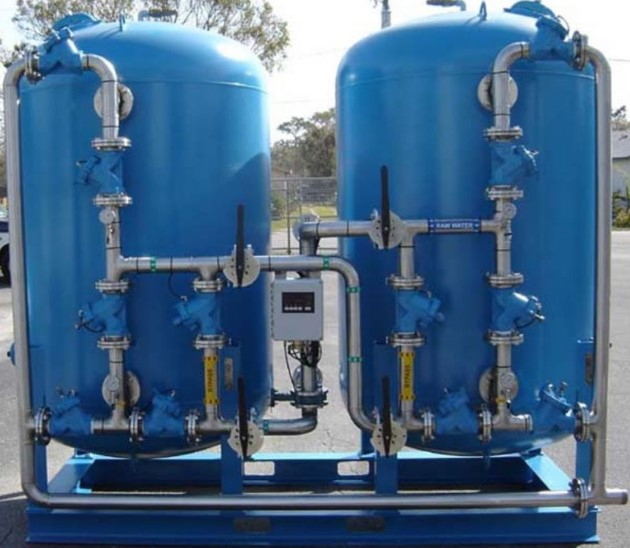
If water demand fluctuates significantly between peak and off-peak periods, a balancing tank may be required, or equipment with surplus capacity should be selected. Continuous operating duration is also important. If the system must run 24 hours a day without interruption, a dual-tank configuration (one in operation and one on standby) is recommended to prevent water supply disruptions during backwashing.
The multi-media concept relies on layered combinations of filter materials with different densities and particle sizes to achieve progressive filtration from coarse to fine. An incorrect media combination will prevent the equipment from delivering expected results, regardless of its quality.
- Quartz sand: The most fundamental filter media, quartz sand removes suspended impurities and reduces turbidity primarily through mechanical interception. It is inexpensive, widely available, and suitable for general surface water, river water treatment, and advanced wastewater treatment. However, it only removes physical impurities and is ineffective against dissolved substances.
- Activated carbon: With extremely strong adsorption capacity, activated carbon removes organic compounds, pigments, residual chlorine, odors, and improves water taste. It is commonly used in drinking water purification, swimming pool treatment, and chlorine removal upstream of RO systems. Its disadvantages include higher cost and the need for replacement or regeneration after adsorption saturation.
- Manganese sand: Specifically designed to remove iron and manganese ions from water, manganese sand is highly effective for groundwater treatment. It is also useful for treating water after rust removal from metal pipelines. Proper aeration is necessary to oxidize ferrous iron into ferric iron for effective interception.
- Anthracite: Positioned between quartz sand and activated carbon, anthracite offers both filtration capability and limited adsorption. It can remove some organic matter and odors, though less thoroughly than activated carbon. Its advantage is lower cost compared to activated carbon, while still being more expensive than quartz sand.
- Fiber balls: This flexible filter media features high porosity and low hydraulic resistance, making it ideal for high-flow scenarios. Its large specific surface area provides strong contaminant interception, particularly for oil removal. It is often used in oily wastewater treatment and landscape water circulation systems.
Based on water characteristics and treatment goals, the industry typically adopts the following configurations:
- Conventional impurity removal combination (anthracite + quartz sand + magnetite): This is the most common three-layer structure. The upper anthracite layer (low density, large particle size) intercepts large particles; the middle quartz sand layer performs primary filtration; the lower magnetite layer (high density, small particle size) provides fine filtration and prevents sand leakage. It is widely used in municipal water supply and industrial circulating water systems.
- Adsorption purification combination (activated carbon + quartz sand): Adding an activated carbon layer above quartz sand enhances adsorption of pigments, odors, and residual chlorine. This configuration is suitable for drinking water treatment, swimming pools, and reclaimed water reuse where sensory quality is important. If residual chlorine levels are particularly high, consider increasing carbon thickness or implementing dual-stage carbon filtration.
- Targeted treatment combination (manganese sand + quartz sand): Designed specifically for groundwater with excessive iron and manganese. Typically, manganese sand forms the upper layer, while quartz sand acts as support and provides fine filtration below. This combination is widely used in well water treatment and rural drinking water safety projects.
Particle size directly affects filtration precision and operating resistance. Smaller particles deliver higher accuracy and cleaner effluent but create greater hydraulic resistance, requiring higher inlet pressure and more frequent backwashing.
Typical particle sizes are:
- Upper layer: 2–4 mm
- Middle layer: 1–2 mm
- Lower layer: 0.5–1 mm
For higher precision, fine sand of 0.3–0.5 mm can be used in the lower layer, but sufficient inlet pressure and stronger backwashing must be ensured.
After selecting filter media, the next step is choosing hardware parameters, which determine installation feasibility, long-term stability, and maintenance convenience.
The filter diameter is primarily determined by treatment capacity using the formula:
Required cross-sectional area = Treatment flow ÷ Design filtration velocity
Typical filtration velocity for multi-media filters is 8–10 m/h. For higher effluent quality, it can be reduced to 5–8 m/h.
For example, treating 50 m³/h at 10 m/h requires a cross-sectional area of 5 m², corresponding to a tank diameter of approximately 2.5 meters.
Filter bed height is equally important. Generally:
- Total filter bed height: 1.0–1.2 m
- Support layer (pebbles/gravel): 0.3–0.4 m
- Media layer: 0.6–0.8 m
Poor raw water quality may require thicker beds, though this increases head loss.
Total tank height must account for upper distribution space, media thickness, lower collection space, and head height. Typical overall height ranges from 2.5 to 3.5 meters to ensure installation and maintenance clearance.
- Fiberglass-reinforced plastic (FRP): Lightweight, easy to transport and install, corrosion-resistant, and moderately priced. Suitable for neutral or mildly acidic/alkaline water and commonly used in rural drinking water projects, small swimming pools, and villa water treatment systems. However, pressure resistance is relatively limited, making it more appropriate for atmospheric or low-pressure systems.
- Rubber-lined or plastic-lined carbon steel: Carbon steel offers high strength, strong pressure resistance, and low cost. With anti-corrosion lining, it can handle corrosive water. It provides excellent cost performance and is widely used in industrial wastewater treatment and large circulating water systems. Lining thickness is typically 3–5 mm, and qualified manufacturers should be selected to prevent lining failure and leakage.
- Stainless steel (304/316): Provides the best corrosion resistance and high sanitary standards without contaminating water. Ideal for drinking water, food and beverage production, and pharmaceutical applications. Grade 316 offers stronger resistance to chloride corrosion than 304 and should be prioritized when chlorine content is high. The main drawback is higher cost.
In addition to the tank, pay attention to materials used for distributors, collectors, and backwash air pipes. These components remain submerged for long periods, and corrosion can contaminate water quality. Stainless steel accessories are recommended to ensure long-term reliability.
Distributor design should ensure uniform flow distribution to prevent localized high velocities that could disrupt the filter bed.
Manual control: Operators manually switch between filtration, backwashing, and rinsing using valves. This option is low-cost, structurally simple, and has a low failure rate, making it suitable for small projects or intermittent operations. However, it requires on-site supervision, and operators must determine backwash timing based on pressure differential or operating duration.
Automatic control: Equipped with differential pressure transmitters, electric valves, and PLC systems. When the pressure differential reaches a set value (typically 0.05–0.08 MPa) or runtime meets the preset limit, the system automatically initiates backwashing and returns to filtration afterward. This is ideal for large water plants and continuous industrial production requiring unattended operation. Although the initial investment is higher, it reduces labor costs and minimizes human error.
Selection should consider not only procurement cost but also lifecycle expenses.
- Energy consumption: Primarily related to pump pressure requirements. Smaller media particles and thicker beds increase head loss and energy consumption but also improve filtration accuracy. A balance must be achieved.
- Backwash water consumption: Backwashing typically consumes 3–5% of total water production. Appropriate backwash intensity and duration should ensure thorough cleaning without unnecessary waste. Some systems use air-water combined backwashing to reduce water usage.
- Media replacement cost: Quartz sand and anthracite generally require replacement every 3–5 years. Activated carbon may need replacement or regeneration every 1–2 years depending on water quality. Properly regenerated manganese sand can last longer. Always include replacement cycles and prices in annual cost calculations.
- Maintenance cost: Includes routine inspections, valve servicing, and control system upkeep. While automatic systems reduce labor, they increase electrical maintenance requirements.
Choosing a reliable supplier is just as important as selecting the equipment itself.
- Technical capability: Prioritize manufacturers with customized design capabilities. Standard products do not suit every operating condition. Strong manufacturers can adjust media gradation, tank height, and distribution methods based on your water quality report.
- Certifications and project experience: Verify production qualifications, pressure vessel manufacturing licenses (if required), and sanitary approvals for drinking water equipment. Pay particular attention to successful projects within the same industry or application type.
- After-sales service: Water treatment equipment requires regular maintenance. Comprehensive support should include installation guidance, commissioning training, media supply, and fault repair. Evaluate local response times, availability of spare parts, and warranty terms. For large systems, signing an annual maintenance contract is recommended to ensure professional upkeep.
Selecting a multi-media filter is a systematic process that requires comprehensive consideration of raw water quality, treatment objectives, media combinations, equipment parameters, material selection, and control methods. Begin with detailed water testing, clearly define effluent standards, and communicate thoroughly with professional manufacturers to obtain solutions tailored to actual operating conditions. Avoid pursuing the lowest price blindly, and do not over-specify equipment unnecessarily, the best choice is the one that fits your needs. With scientific selection and proper operation, a multi-media filter can serve as a reliable first line of defense in water treatment systems, providing stable, high-quality influent for downstream processes.
