In industrial production and energy storage systems, storage tanks are essential equipment used for containing gases, liquids, and other media. Among various structural forms, the spherical storage tank is a special type characterized by its spherical geometry. Compared with conventional cylindrical storage tanks, spherical tanks exhibit distinct mechanical behavior and material utilization characteristics.
This article provides a comprehensive overview of spherical storage tanks, covering their core components, structural advantages, limitations, support systems, industry standards, comparison with other tank types, and practical industrial applications. The aim is to help readers gain a complete understanding of the engineering characteristics of this type of pressure vessel.
A spherical storage tank is composed of several key components that collectively ensure structural integrity and operational safety. The most critical part is the spherical shell. Due to its unique geometric form, the spherical shell enables uniform distribution of internal pressure, significantly reducing stress concentration and improving overall structural strength.
The tank is typically installed on a dedicated support structure. This structure bears the full weight of the tank and its internal medium, ensuring operational stability. Various support forms are used in practice, including leg supports, ring foundations, or conical skirt supports.
For maintenance and inspection purposes, spherical tanks are equipped with manholes and access openings. These allow operators to enter the tank for inspection, repair, and cleaning activities. In addition, multiple nozzle connections are installed on the tank body. These interfaces are used for fluid inlet and outlet operations as well as instrumentation measurements.
Furthermore, the drainage and ventilation system is an essential component of spherical storage tanks. This system controls liquid discharge and gas release, ensuring safe and stable operation of the entire storage system.
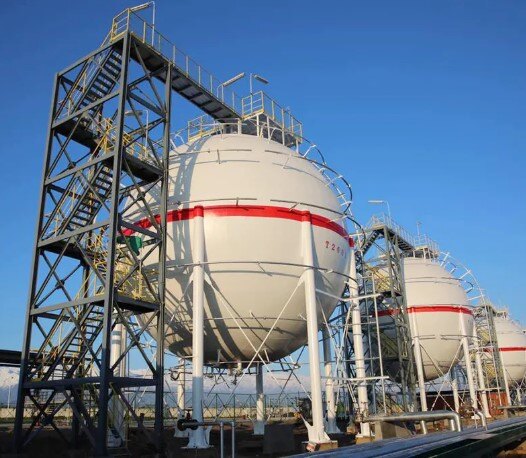
The widespread use of spherical storage tanks in high-pressure and low-temperature storage applications is primarily due to their geometric advantages, which provide superior structural performance in several aspects compared to cylindrical tanks.
Spherical storage tanks exhibit excellent structural integrity. Their geometry allows internal pressure to be evenly distributed across the entire shell surface, ensuring consistent stress in all directions. This effectively eliminates localized stress concentration. Under the same wall thickness, spherical pressure vessels can withstand higher internal pressures than other shapes.
Spherical tanks require less material for the same internal volume, resulting in improved material efficiency and reduced manufacturing cost. In engineering design, the hydrostatic pressure varies with height, so wall thickness can be optimized accordingly. The lower portion of the tank can be designed with increased thickness to match higher pressure loads, further improving material utilization.
The spherical structure occupies a relatively small ground area, making it suitable for industrial sites with limited space. In addition, spherical tanks demonstrate excellent seismic performance and are particularly advantageous in earthquake-prone regions. Unlike cylindrical structures, spherical tanks are less likely to tilt or experience localized instability under lateral forces.
Due to their relatively smaller surface area, spherical tanks reduce heat exchange with the external environment. This characteristic is especially beneficial for storing cryogenic or low-temperature media such as liquefied natural gas (LNG) or liquid nitrogen, where thermal insulation is critical.
Despite their significant advantages in stress distribution and material efficiency, spherical storage tanks are not suitable for all engineering scenarios. Several limitations restrict their broader application.
The manufacturing process of spherical tanks is complex and requires advanced forming and welding technologies. The steel plates must undergo multi-directional forming, high-precision welding, and careful assembly. This increases production difficulty, extends manufacturing time, and raises overall cost.
Spherical tanks are not suitable for large-scale capacity expansion. Any increase in storage volume requires proportional enlargement of the entire sphere, rather than linear extension. This limits their applicability in large-scale storage systems where flexible expansion is required.
Transportation and installation of spherical tanks are relatively difficult. They often require complex lifting operations and on-site assembly. Typically, the tank is composed of prefabricated segments, including upper and lower shells and equatorial ring plates, which must be welded together on site.
Spherical tanks have significant self-weight, and as diameter increases, the length and load-bearing requirements of support legs increase accordingly. From a structural mechanics perspective, tank volume increases with the cube of diameter, while support weight increases at an even faster rate. This makes the support system a major cost component in large spherical tank designs and affects overall stability and buckling resistance.
To address the high cost and structural challenges of support systems, several support configurations are commonly used in engineering practice.
The first method involves placing the spherical tank directly on a large reinforced concrete foundation. This foundation is typically circular or ring-shaped, with a diameter approximately half that of the tank. It provides uniform load distribution and reduces localized stress concentration.
The second method uses a conical skirt support structure. This design offers high rigidity and strong buckling resistance, performing well under dynamic loading conditions and providing enhanced structural stability.
During manufacturing, reinforcing pads are welded in the equatorial region, and column connection structures are installed to link the tank to the support system effectively.
The design and manufacturing of spherical storage tanks must comply with strict engineering standards to ensure safety and reliability.
Key standards include API 620, which governs the design and construction of large low-pressure storage tanks. ASME Section VIII Division 1 provides guidelines for pressure vessel design. European standards such as EN 14015 apply to above-ground vertical cylindrical steel tanks, contributing to overall regulatory frameworks.
During manufacturing, steel plates are typically formed using a four-roll plate bending machine to achieve spherical curvature. Templates are used to verify geometric accuracy. After fabrication, upper and lower heads and nozzle areas often undergo stress-relief heat treatment to reduce residual welding stress and improve long-term operational reliability.
Compared with other storage tank types, spherical tanks offer superior stress distribution and structural strength, as well as reduced footprint. However, they are more complex to manufacture and more difficult to maintain and inspect.
Cylindrical storage tanks are simpler in structure and easier to manufacture, but their stress distribution is less uniform. They typically have flat-bottom designs and vertical cylindrical walls, making them more susceptible to external environmental effects such as flooding, corrosion, and foundation settlement.
Bullet-shaped tanks offer large capacity but suffer from stress concentration issues. Cryogenic tanks perform well in thermal insulation, while underground tanks provide different spatial advantages. Therefore, each tank type has its own suitable application scenarios, and selection must be based on actual engineering conditions.
From the perspective of capacity expansion and engineering flexibility, cylindrical pressure vessels have clear advantages. When storage capacity needs to be increased, the vessel length or diameter can be adjusted easily, making expansion more flexible and efficient during plant upgrades.
From a manufacturing standpoint, cylindrical vessels are produced using a modular approach. Shell sections and heads are fabricated separately and then welded together, improving production efficiency and making them more suitable for large-scale industrial applications.
In modern industrial systems, spherical storage tanks are widely used in the oil and gas industry for liquefied gas storage, in petrochemical industries for raw material storage, in aerospace applications for propellant storage, and in cryogenic gas storage systems.
Their excellent structural performance makes them indispensable in high-pressure and low-temperature environments. Spherical tanks are generally more suitable for large-capacity storage applications and are commonly recommended for diameters exceeding approximately 10 meters.
They are widely used for storing water, petroleum, fracturing chemicals, and toxic media in various industrial environments. Engineering designs also consider flood conditions, wind loads, and foundation characteristics in accordance with relevant standards. Different tank types, including cylindrical and spherical structures, are selected based on specific operating conditions, and no single type is universally optimal.
From a theoretical standpoint, spherical pressure vessels represent one of the most efficient geometries for resisting internal pressure. They are often considered an ideal structural form in classical mechanics due to their uniform stress distribution.
However, in real industrial applications, cylindrical pressure vessels are more commonly used. This is mainly because engineering practicality, manufacturing feasibility, and economic considerations play a more decisive role in design decisions.
Spherical storage tanks offer excellent structural performance and high material efficiency in high-pressure and large-capacity applications, but their manufacturing complexity and stringent support requirements limit their widespread use. Ultimately, the selection of pressure vessel geometry represents a balance between mechanical performance and engineering economics. Cylindrical pressure vessels dominate industrial applications due to their lower cost, higher flexibility, and more mature manufacturing processes.
