In the process industries, atmospheric and low-pressure storage tanks are indispensable pieces of equipment, responsible for storing a wide range of liquid media. However, these tanks face many challenges during operation, among which fluctuations in internal pressure are the most critical. When the liquid level inside a tank changes or when ambient temperature varies, the gas within the tank expands or contracts accordingly, causing fluctuations in vapor-phase pressure. Such pressure variations can easily lead to overpressure or vacuum conditions inside the tank. In severe cases, this may result in tank bulging due to overpressure or tank collapse due to excessive vacuum, leading to significant economic losses for enterprises and posing potential threats to personnel safety and the environment.
To effectively address this issue, breather valves are typically installed on the tank roof during process design. As an important safety accessory, a breather valve primarily functions to maintain pressure balance within the storage tank, ensuring that the tank is protected from damage under overpressure or vacuum conditions. At the same time, it helps reduce evaporation and loss of stored materials, thereby contributing to both safety and environmental protection.
A breather valve consists of a pressure valve and a vacuum valve. It is installed on atmospheric or low-pressure storage tanks and automatically opens or closes in response to positive or negative pressure changes inside the tank, keeping the pressure differential between the inside and outside of the tank within allowable limits. Its operation is based on the following two processes.
- Venting Process: When the temperature inside the storage tank rises, the gas volume expands and internal pressure increases. At this point, the breather valve automatically opens to release excess pressure, preventing damage caused by overpressure. This process is known as venting or breathing. For example, when liquid is being added to a tank, the pressure in the vapor space above the liquid increases. Once it reaches the breather valve’s set positive operating pressure, the pressure valve is pushed open and gas is discharged through the vent outlet, preventing further pressure buildup inside the tank.
- Inhalation Process: Conversely, when the temperature inside the tank decreases, the gas contracts and internal pressure drops. The breather valve then opens to allow external air to enter the tank, preventing excessive vacuum that could cause the tank to collapse. This process is known as inhalation. For example, when liquid is withdrawn from the tank, the pressure in the vapor space decreases. When it reaches the breather valve’s set negative operating pressure, atmospheric pressure pushes open the vacuum valve disc, allowing outside air to enter the tank. This prevents further pressure reduction and restores pressure balance between the inside and outside of the tank.
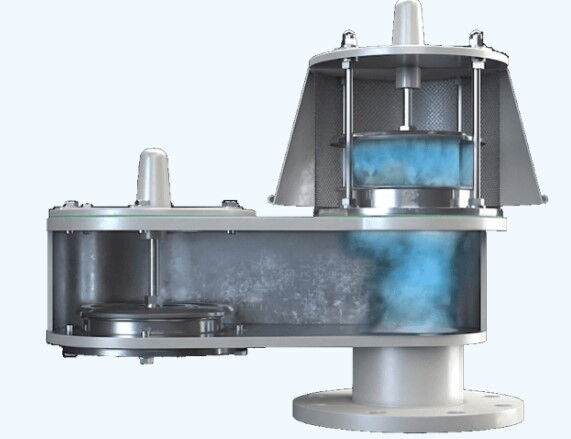
With continuous advances in industrial technology, a variety of breather valve designs have emerged. Common types include set-screw breather valves, packing-type breather valves, self-sealing breather valves, and oil-sealed breather valves with forced lubrication.
- Set-Screw Breather Valves: Set-screw breather valves are typically used in low-pressure straight-through piping. Their sealing performance relies entirely on the degree of fit between the plug and the valve body. Sealing is achieved by tightening the lower nut to compress the sealing surfaces. They are generally suitable for applications with nominal pressure (PN) not exceeding 0.6 MPa. These valves feature a simple structure and convenient operation, but their sealing performance is relatively weak under higher-pressure conditions.
- Packing-Type Breather Valves: Packing-type breather valves achieve sealing between the plug and the valve body by compressing packing material. Due to the presence of packing, they offer improved sealing performance. These valves are usually equipped with a packing gland, and the plug does not protrude outside the valve body, thereby reducing one potential leakage path for the process medium. They are widely used in pressure environments with nominal pressure not exceeding 1.0 MPa and are suitable for applications with higher sealing requirements.
- Self-Sealing Breather Valves: Self-sealing breather valves use the pressure of the medium itself to achieve tight sealing between the plug and the valve body. The smaller end of the plug extends upward outside the body, and the medium enters the larger end of the plug through a small inlet hole, pushing the plug upward to achieve sealing. This structure is generally used for air service and features automatic sealing, allowing it to maintain good sealing performance without external force.
- Oil-Sealed Breather Valves with Forced Lubrication: As the application range of breather valves has expanded, oil-sealed breather valves with forced lubrication have been developed. These valves use forced lubrication to form an oil film between the sealing surfaces of the plug and valve body, significantly improving sealing performance while reducing operating effort during opening and closing. This design also effectively prevents damage to the sealing surfaces. Such breather valves are suitable for applications with high requirements for sealing performance and service life, helping to reduce medium leakage and equipment maintenance costs.
Proper installation and maintenance of breather valves are essential to ensure reliable operation. The following are key considerations:
- Installation Location: Breather valves should be installed at the highest point on the tank roof to ensure smooth gas flow in and out of the tank during pressure changes, thereby maintaining pressure balance. If two breather valves are required, they should be arranged symmetrically to ensure balanced pressure and avoid uneven loading.
- Special Requirements for Nitrogen-Blanketed Tanks: When installing breather valves on nitrogen-blanketed tanks, the nitrogen supply line should be positioned away from the breather valve connection, and the inlet pipe should extend 200 mm into the tank. This prevents nitrogen from being discharged directly through the breather valve, helps maintain the nitrogen blanket, prevents air ingress, and reduces oxidation of the stored medium.
- Anti-Freezing Measures: If the average temperature of the coldest month in the operating area is at or below 0 °C, anti-freezing measures must be taken. These may include installing heating systems (such as electric heaters, steam tracing, or hot water circulation), wrapping the valve and associated piping with insulation materials (such as insulation cotton or foam), selecting breather valves with anti-condensation designs (e.g., low-temperature-resistant materials or built-in heating elements), and installing drainage devices at low points of the valve and piping. These measures ensure that the breather valve and nearby piping remain above freezing temperature, preventing blockage caused by frozen condensate.
- Regular Inspection: After proper installation, breather valves should be inspected at least every six months to check whether the screens are blocked or corroded. Any blockage should be removed promptly to keep the screens clean. In addition, breather valves should be function-tested annually to ensure that their operating pressures remain within normal ranges. Valves that fail annual inspections should be replaced promptly rather than left in service as inactive fixtures, which could create serious safety hazards.
- Heating System Maintenance: For breather valves equipped with heating systems, regular checks should be carried out to ensure proper operation of the heating system, integrity of insulation materials, and unobstructed drainage. In some cases, a small amount of antifreeze may be added to the tank to lower the freezing point of the liquid, reducing the risk of valve freezing.
- Environmental Optimization: Avoid installing breather valves in locations exposed to direct cold airflow, which increases the risk of condensation and freezing. Optimize tank operating procedures—for example, by reducing the frequency of tank turnover—to minimize temperature fluctuations inside the tank and lower the risk of breather valve freezing. Temperature sensors may also be used to monitor ambient conditions so that preventive measures can be taken when temperatures fall below freezing.
In storage tank design and operation, vent holes are another commonly used device in addition to breather valves. Vent holes are typically used for media with low volatility and low toxicity, such as diesel oil, kerosene, and firewater. They are usually installed on the top course of the shell of dome-roof tanks to provide natural ventilation between the tank interior and the atmosphere, thereby maintaining pressure balance.
However, for highly volatile or more hazardous media, such as benzene and gasoline, breather valves should be installed on the tank roof. Breather valves are often used in conjunction with internal floating-roof tanks and can be combined with nitrogen blanketing systems to reduce evaporation losses and prevent air ingress, thereby maintaining product purity and preventing oxidation. Compared with vent holes, breather valves are far more effective in reducing product loss and conserving materials. This is because breather valves open and close automatically in response to pressure changes, whereas vent holes remain permanently open and cannot prevent evaporation or leakage.
It should be noted that a single storage tank should not be equipped with both a breather valve and a vent hole. The continuous openness of a vent hole would prevent the breather valve from effectively controlling the pressure differential between the inside and outside of the tank, thereby reducing its effectiveness and rendering the breather valve incapable of regulating pressure as intended.
The installation and use of breather valves not only protect storage tanks from damage caused by pressure fluctuations but also provide multiple comprehensive benefits.
- Safety Benefits: By automatically regulating the pressure differential between the inside and outside of the tank, breather valves ensure that tanks are not damaged by excessive pressure or vacuum during normal operation. This effectively prevents structural damage such as bulging or collapse, which is critical for personnel safety and reliable equipment operation.
- Environmental Benefits: Volatile media stored in tanks expand and contract with temperature changes, leading to pressure fluctuations. Breather valves promptly regulate these changes, reducing evaporation and leakage and thereby minimizing environmental pollution. When used in combination with gas blanketing systems, such as nitrogen blanketing, breather valves further reduce evaporation losses and prevent air ingress, avoiding oxidation or contamination of the stored material. This is essential for maintaining product quality and preventing unwanted chemical reactions.
- Economic Benefits: By reducing evaporation and material losses, breather valves improve the economic efficiency of material storage and help enterprises reduce waste and save costs. Proper installation and maintenance also reduce the frequency of equipment repair and replacement, lowering overall operating costs.
- Fire Prevention Benefits: When used in conjunction with flame arresters, breather valves can effectively prevent ignition of tank contents caused by sparks or flames, thereby avoiding explosions. This plays an important role in ensuring safe production and reducing fire risks.
As a critical safety accessory in storage tank systems, breather valves play an irreplaceable role in ensuring tank safety, reducing material losses, protecting the environment, and improving economic efficiency. Through proper selection, installation, and maintenance, enterprises can maximize the advantages of breather valves while minimizing potential risks. In practical applications, breather valves should be selected based on tank type, properties of the stored medium, and operating environment, and installed and maintained in strict accordance with relevant standards and specifications to ensure reliable operation and long-term safety and stability of storage tank systems.
