In the field of water treatment, multimedia filters are widely used due to their ability to effectively remove suspended solids, colloids, and organic impurities through a combination of filter media with different densities and particle sizes. However, as operation continues, large amounts of contaminants accumulate within the filter bed, leading to reduced filtration efficiency and increased pressure drop. Therefore, regular and efficient backwashing is essential, not only to restore filter performance but also to extend the service life of the filter media. This article provides a detailed guide on how to significantly improve the backwash effectiveness of multimedia filters by optimizing backwash parameters, refining operational methods, and strengthening filter media condition management.
Multimedia filters typically consist of multiple layers of filter media, such as anthracite, quartz sand, and garnet. This layered structure is designed so that the upper, lower-density media captures larger particles, while the lower, higher-density media retains finer particles, thereby achieving efficient filtration. Over time, however, contaminants gradually clog the filter bed, resulting in reduced filtration efficiency and increased differential pressure.
The purpose of backwashing is to remove accumulated impurities from the filter media through physical and/or chemical means, restoring media cleanliness and filtration capacity. The basic principle of backwashing is to use reverse water flow or air flow to expand the filter bed and create strong turbulence. This loosens contaminants trapped between media particles and carries them out of the filter.
Air–water combined backwashing is particularly effective. Air introduced into the filter bed creates intense agitation, causing strong friction between media particles. This action efficiently detaches sticky contaminants, such as colloids, algae, and organic matter, from the media surfaces. The subsequent water flow then flushes these loosened impurities out of the filter, achieving deep cleaning.
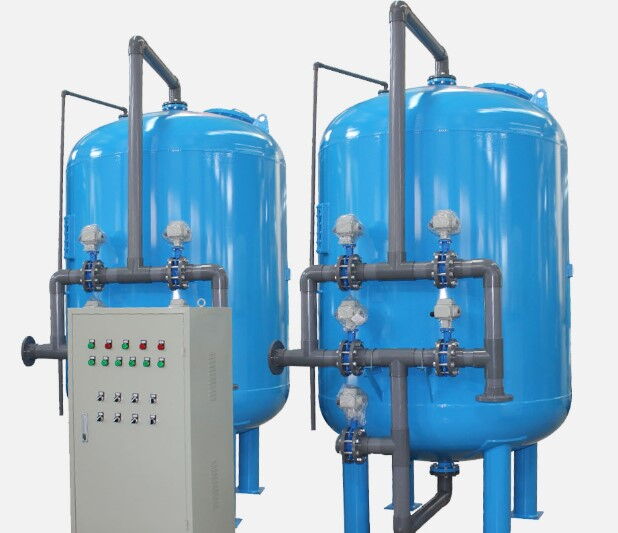
Proper configuration of backwash parameters lies at the heart of improving the backwash performance of multimedia filters.
Backwash intensity (the flow rate of backwash water or air) is one of the most critical parameters affecting backwash performance. Different types of media, particle sizes, and contaminant characteristics require different intensities:
Low-density, coarse media (e.g., anthracite): Require lower backwash intensity, typically 8–12 L/(m²·s), to prevent media loss and disturbance of the layered structure.
Medium-density, medium-size media (e.g., quartz sand): Require moderate intensity, typically 10–15 L/(m²·s), to ensure a bed expansion rate of 50%–60%.
High-density, fine media (e.g., garnet): Require higher intensity, typically 15–20 L/(m²·s), to adequately expand the bed and prevent pore blockage.
Backwash time is equally important. Insufficient duration results in incomplete contaminant removal, while excessive duration wastes water and energy.
Single water backwash: Typically 8–15 minutes, depending on the degree of fouling.
Air–water combined backwash: Total duration 10–15 minutes, generally divided into:
Air scour: 2–3 minutes
Air–water simultaneous wash: 3–5 minutes
Water rinse: 5–8 minutes
Rather than relying solely on fixed time, the end point of backwashing should be determined by the effluent turbidity. When the backwash effluent turbidity stabilizes below 5 NTU, backwashing can be stopped.
The expansion rate of the filter bed is a direct indicator of whether backwash intensity is appropriate. Different media combinations have different optimal expansion rates:
Single quartz sand layer: 50%–60%
Anthracite layer: 40%–50%
Uniform bottom water distribution (layered or zoned water distribution) is essential to prevent localized under-expansion or over-expansion.
Beyond parameter optimization, refining operational procedures is critical for enhancing backwash effectiveness. Scientific and well-designed backwash sequences can more effectively remove contaminants while preventing media loss or intermixing.
Air–water combined backwashing is far superior to water-only backwashing. A typical procedure is as follows:
Air Scour Stage: Introduce compressed air at a pressure of 0.1–0.15 MPa, with an air flow rate of 10–15 L/(m²·s) for 2–3 minutes. The purpose is to loosen the filter media and break adhesive bonds between particles.
Air–Water Mixed Stage: Introduce air and backwash water simultaneously, with air at 8–12 L/(m²·s) and water at 5–8 L/(m²·s) for 3–5 minutes. The synergistic action of air and water provides deep cleaning of contaminants within media pores.
Water Rinse Stage: Continue with water-only backwashing, gradually increasing the water flow until the filter bed is fully expanded. Maintain for 3–5 minutes to flush out remaining impurities until the effluent runs clear.
After the main cleaning stage, backwashing should not be stopped immediately. A low-intensity rinse (50%–60% of the normal water-only backwash intensity, for 1–2 minutes) is recommended. This step removes residual fine contaminants on the surface of the filter bed, prevents high initial turbidity upon restart, and allows the media to settle smoothly, reducing layer disturbance.
Effective filter media management is essential for long-term stable operation. The condition of the media directly affects both filtration efficiency and backwash performance, making regular maintenance crucial.
Soaking Treatment: If backwashing has been ineffective for a long period, media may become compacted, especially when raw water has high hardness or high organic content. In such cases, soak the media in a 1%–3% hydrochloric acid or citric acid solution for 4–8 hours to dissolve scale and organic matter, followed by backwashing.
Media Replenishment: Over time, filter media may wear or break, resulting in smaller particle sizes and clogged pores. When media loss exceeds 5%, new media should be added.
Complete Replacement: After 3–5 years of operation (depending on contamination level), the entire filter media should be replaced to ensure particle size and density meet design requirements.
Backwash water quality has a significant impact on backwash effectiveness. Preferred sources include filtered effluent, reverse osmosis permeate, or clarifier supernatant, with turbidity controlled below 1 NTU. If backwash water is recycled, it should be settled or filtered first to prevent contaminant accumulation.
When sticky contaminants such as colloids, microorganisms, or oils accumulate, physical backwashing alone may be insufficient. Chemical assistance can be applied:
Oxidants: Add 0.5–1 mg/L residual chlorine (or 50–100 mg/L hydrogen peroxide) during backwashing to oxidize organic matter and enhance cleaning.
Acid Cleaning: Prior to backwashing, soak the media in 1%–2% sulfuric or hydrochloric acid for 2–4 hours to dissolve iron and manganese oxides, followed by normal backwashing.
Citric or Oxalic Acid Cleaning: Soak in 1%–3% citric or oxalic acid to dissolve scale, then backwash.
When facing fluctuations in raw water quality, high pollution loads, and other complex operating conditions, adopting targeted strategies and measures can effectively reduce backwashing difficulty, improve filtration efficiency, and ensure stable filter performance under a wide range of conditions. The following sections outline specific approaches for addressing these special scenarios.
When raw water turbidity is high (e.g., >50 NTU) and contains large amounts of colloids or organic matter, the filter bed clogs rapidly, increasing backwash frequency and reducing effectiveness. Pretreatment is essential:
Coagulation and Sedimentation:
Add coagulants such as PAC and PAM to form larger flocs. Sedimentation can remove 60%–80% of turbidity, reducing influent turbidity to below 20 NTU.
Pre-Oxidation:
Apply chlorine or ozone to degrade organic matter before filtration.
Oil Separation or Demulsifier Addition:
Prevent oil from adhering to filter media and hindering backwashing.
For filters not originally designed with air scour systems, retrofitting with bottom air distribution devices (e.g., perforated pipes with air diffusers) is recommended. During backwashing, introduce compressed air at 15–25 L/(m²·s) for 2–3 minutes before water backwashing. Air bubbles provide strong agitation, penetrate deeper into the bed, loosen sticky contaminants, and prevent compaction. This can reduce subsequent water backwash intensity by 20%–30% and water consumption by 15%–20%.
In severely polluted scenarios (e.g., industrial wastewater pretreatment or rainy seasons), a backwash sequence of 1–2 minutes air scour → 3–4 minutes air–water combined wash → 2–3 minutes water rinse is recommended. Compared with water-only backwashing, contaminant removal efficiency can increase by 30%–40%, while total backwash time can be reduced by 25%.
If backwash intervals are too long, contaminants penetrate deep into the filter bed and become difficult to remove; if too short, resources are wasted. Backwashing should be initiated when the inlet–outlet differential pressure reaches 0.05–0.1 MPa (initial differential pressure is typically <0.02 MPa). Even if this threshold is not reached, at least one backwash per day is recommended, especially when raw water quality fluctuates significantly.
Improving the backwash effectiveness of multimedia filters is a systematic task that requires coordinated optimization of backwash parameters, operational methods, and filter media management. By properly adjusting backwash intensity, duration, and bed expansion rate, and by applying air–water combined backwashing and chemical assistance, backwash performance can be significantly enhanced, restoring filtration capacity. Targeted pretreatment for special operating conditions further reduces contaminant load and backwash pressure, extending backwash cycles. Regular media maintenance and appropriate selection of backwash water are also critical to achieving reliable results. By implementing these measures, multimedia filters can consistently operate in optimal condition, providing dependable support for water treatment processes. We hope this guide is helpful. If you have any questions or require further technical support, please feel free to contact us at any time.
