In the fields of petroleum, chemical engineering, and natural gas processing, storage tanks and surge tanks are two commonly used types of pressure vessels. Although they may appear similar in structure, they differ significantly in functional positioning, design philosophy, and operational scenarios. In many industrial sites, confusion between the two has led to selection errors, operational failures, or safety risks. This article explains the essential differences between storage tanks and surge tanks from the perspectives of core functions, structural characteristics, selection considerations, and practical applications.
The primary function of a storage tank is material storage and turnover. It is used to decouple upstream supply and downstream consumption, solving mismatches in production and usage rhythms, such as continuous upstream production with intermittent downstream consumption, or centralized material unloading with continuous material usage. The focus of storage tanks lies in inventory capacity and operational boundaries, including whether the volume meets the required storage cycle, whether material charging and discharging are convenient, whether drainage and cleaning are thorough, and whether maintenance and switching operations are smooth.
Storage tanks require relatively defined liquid level management, while their ability to handle instantaneous pressure or flow fluctuations is not the primary design objective. Therefore, storage tanks emphasize loading and unloading convenience, measurement management, tank farm layout, and regulatory safety compliance. They are commonly used for storing raw materials, intermediate products, finished products, and utility media. In some cases, storage tanks also serve as backup or emergency inventory facilities to reduce production interruption risks caused by supply delays or short-term downstream fluctuations.
The primary role of a surge tank is to absorb system fluctuations and stabilize operating boundaries. Surge tanks are typically installed at locations where pressure or flow variations are significant, such as compressor inlets and outlets, main gas pipelines, feed sections before reactors, distribution sections with concentrated gas consumption, or upstream and downstream positions of evaporation and vaporization systems.
The value of a surge tank lies in providing adjustable or compressible working volume. When instantaneous flow is excessive, the tank temporarily absorbs the surplus fluid; when flow decreases, the tank releases stored medium to maintain stable downstream supply.
In gas systems, surge tanks function as pressure stabilizers and load peak-shaving devices. In liquid systems, they mainly improve flow stability, reduce frequent pump start-stop cycles, and mitigate the risk of water hammer in pipeline networks. Surge tank capacity does not aim for large inventory storage but rather sufficient buffering time, and the selection logic should comprehensively consider fluctuation amplitude, allowable variation range, control response speed, and process switching frequency.
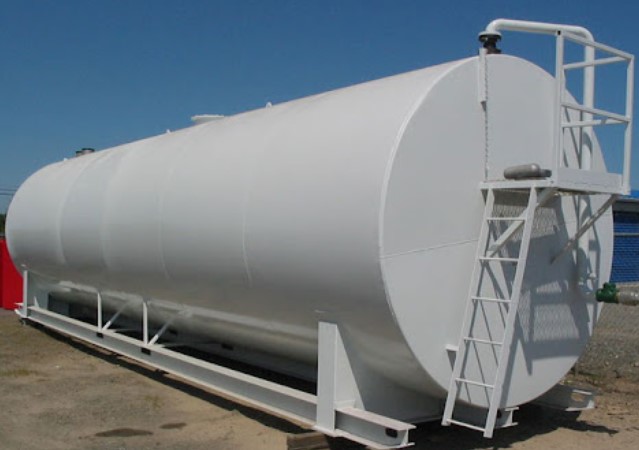
Storage tanks usually have large capacities to accommodate substantial quantities of liquid or gas and ensure stable material supply. Depending on the properties of the stored medium, storage tank design may include corrosion-resistant materials, thermal insulation layers, and mixing devices to guarantee long-term storage safety.
Common storage tank types include vertical tanks, horizontal tanks, and spherical tanks, selected according to specific engineering requirements. Storage tanks are equipped with safety valves, pressure relief devices, and liquid level monitoring systems to ensure operational safety during long-term storage.
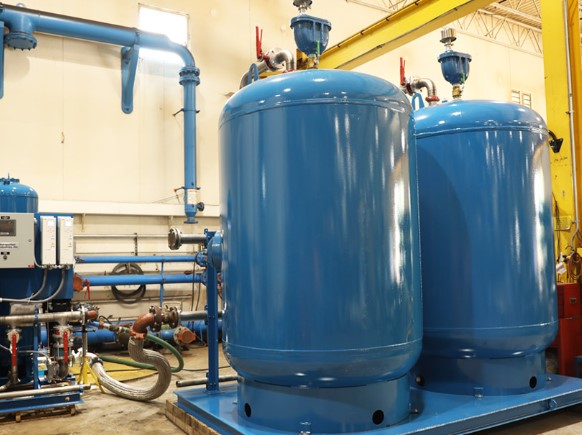
Surge tanks are designed to absorb pressure or flow fluctuations within the system and ensure stable downstream operation. Compared with storage tanks, surge tanks generally have smaller capacities but more complex internal flow structures to meet fluid regulation requirements.
Surge tanks are built to withstand pressure variations and are equipped with inlet and outlet pipelines, pressure gauges, and safety valves. They are widely used in petroleum, chemical, natural gas, and water treatment industries, especially in processes requiring continuous and stable operation.
Although both devices are capable of holding fluids, surge tanks should not be used as substitutes for storage tanks due to differences in design purpose and structural configuration.
Functional positioning differs. Storage tanks are designed for bulk liquid or gas storage to ensure long-term or short-term material supply, while surge tanks are used to regulate flow and pressure fluctuations to maintain stable downstream process operation.
Material and structural differences also exist. Storage tanks are constructed using materials capable of long-term resistance to medium corrosion, often incorporating protective coatings or special alloy materials, and are equipped with ventilation, heating, cooling, and mixing systems. Surge tanks are primarily designed to absorb pressure and flow disturbances and may not possess the corrosion resistance and volumetric capacity required for long-term storage.
The completeness of safety protection systems also varies. Storage tanks are typically equipped with comprehensive safety valves, pressure relief devices, and level monitoring instruments. Surge tanks mainly function as balancing and regulating units and may lack the extensive safety monitoring systems of storage tanks, making long-term storage potentially hazardous.
Application scenarios are also different. Storage tanks are used for storing crude oil, finished petroleum products, and chemical media that require long-term stable storage. Surge tanks are mainly used to balance flow and pressure to ensure smooth operation of oil and gas processing systems, functioning as process components rather than independent storage facilities.
In emergency situations, surge tanks may be temporarily used as storage vessels, but such practice does not conform to design standards and safety requirements. To ensure safe and reliable industrial operation, dedicated storage tanks should be selected for material storage, while surge tanks should be used for their intended regulation and buffering functions.
Typical application scenarios of surge tanks include compressor discharge systems to absorb pulsation and short-cycle fluctuations, pre-consumption gas supply sections for peak shaving and valley filling, venting systems to absorb flow disturbances during process switching, and feed stabilization systems before reactors.
Surge tanks are also commonly combined with separation, condensation, filtration, and drying units to provide integrated functions of pressure stabilization, flow buffering, and liquid or sediment interception.
Selection should start from operating boundaries and system control strategies, including medium type, pressure range, temperature range, upstream supply mode, downstream consumption characteristics, pipeline network volume, and allowable pressure fluctuation limits. Whether condensation water, oil mist, or corrosive components exist must also be evaluated.
For compressed air systems, moisture and condensation management is critical for long-term reliability. If drainage design is inadequate, accumulated liquid inside the tank may accelerate internal corrosion, reduce effective volume, or cause water hammer and downstream equipment contamination.
Surge tanks are commonly designed in vertical or horizontal configurations. Vertical surge tanks occupy a smaller footprint and are suitable for station buildings or tank farm layouts, while horizontal surge tanks have lower height requirements and are suitable for space-constrained environments or installations close to process equipment.
The inlet configuration should avoid high-speed jet impingement on the vessel wall. Drainage and sludge removal ports should be located at the true lowest point and remain easily accessible. Venting and safety protection pathways should be clearly designed, and instrument interfaces should meet operational monitoring and interlock control requirements.
Material selection should match the properties of the medium. Carbon steel is generally suitable for clean air or inert gases, while stainless steel or special alloys are required for corrosive or high-purity media.
It should be noted that corrosion inside surge tanks is often caused by the combined effects of moisture, condensate, and impurities, particularly when drainage is poor, localized liquid accumulation occurs, or ventilation is insufficient during shutdown periods.
General-purpose storage tanks include vertical and horizontal tanks made of carbon steel or stainless steel, used for medium storage and system buffering under normal temperature or medium-temperature conditions. Selection requires clarification of medium type, design pressure and temperature, and capacity requirements, while considering site layout, drainability, maintenance convenience, and long-term sealing reliability.
Process system vessels are designed for stabilizing pressure and flow at key process nodes, gas-liquid separation, flash buffering, condensate collection, and mixture homogenization. The key selection factors include available differential pressure, effective gas-phase volume, residence time, and control bandwidth matching to ensure absorption of transient deficits, smoothing of pulsation peaks, and prevention of liquid carryover or liquid level oscillation.
High-purity gas vessels are used for storing and stabilizing high-purity hydrogen, helium, nitrogen, and other clean gases under pressure. The primary focus is maintaining clean boundaries and sealing integrity, minimizing interface numbers and dead zones, and smoothing transient disturbances caused by simultaneous gas consumption or switching operations.
Cryogenic storage tanks are designed for liquefied natural gas, liquid oxygen, liquid nitrogen, and liquid argon storage. Thermal intrusion determines boil-off gas generation and pressure fluctuations, while insulation performance determines long-term thermal efficiency. The venting, recovery, pressure stabilization, and safety release pathways must form a closed-loop protection system.
Liquefied gas storage tanks are used for LPG, propane, butane, and other liquefied hydrocarbon storage, unloading, and gas supply. Key safety boundaries include explosion hazard control, safe relief discharge routing, liquid-phase fluctuation stability, and corrosion protection management for buried or earth-covered structures.
Storage tanks and surge tanks are fundamentally different equipment types. Storage tanks are inventory-type vessels that emphasize large capacity, long-term safe storage, and loading/unloading convenience. Surge tanks are regulation-type vessels designed to rapidly respond to system fluctuations, stabilize pressure and flow, and protect process equipment.
During selection, the primary consideration should be the functional role of the vessel within the system: whether it is intended to resolve supply-demand rhythm mismatches or stabilize operational fluctuations, and whether long-term inventory storage or dynamic buffering is required.
Correctly understanding the essential differences between the two can prevent situations where oversized storage tanks are used in place of surge tanks, resulting in slow system response, or where surge tanks are used as storage vessels, creating safety risks. Proper selection ensures long-term stable, safe, and economical operation of industrial installations.
