In industrial production, heat exchangers are indispensable equipment used to facilitate heat exchange between different fluids. Among them, fixed tube sheet heat exchangers are widely used due to their simple structure and relatively low cost. However, these heat exchangers face a thorny issue during operation, namely thermal stress caused by temperature differences. This article delves into the problem of thermal stress in fixed tube sheet heat exchangers and the key solution of expansion joints, helping readers better understand their working principles, design considerations, and practical applications.
Fixed tube sheet heat exchangers mainly consist of a tube bundle and a shell. The tube bundle is responsible for heat exchange between fluids, while the shell serves to contain and protect the tube bundle. During the heat exchange process, there is often a certain temperature difference between the tube bundle and the shell. Since the tube sheet, tube bundle, and shell are rigidly connected, when the temperature difference reaches a certain level, excessive thermal stress is generated. This stress can lead to shell failure, causing leakage and other safety accidents; it can also cause the tube bundle to bend and deform, affecting heat exchange efficiency, and may even pull the tube bundle off the tube sheet, severely impacting the normal operation of the heat exchanger.
To address the thermal stress issue in fixed tube sheet heat exchangers, the expansion joint was designed as an ingenious device. An expansion joint is a flexible component installed on the shell of the heat exchanger, with its core component being the bellows. The bellows have a unique structure that can produce a significant axial deflection, allowing noticeable deformation even under a small axial force. It is this deformable characteristic that enables the expansion joint to compensate for the deformation difference between the tube bundle and the shell.
Specifically, the expansion joint can effectively reduce the thermal stress between the tube bundle and the shell caused by temperature differences. When the tube bundle and shell expand differently due to temperature differences, the expansion joint can absorb this expansion difference through its own deformation, thereby preventing the tube bundle from being pulled off the tube sheet, ensuring the safe and stable operation of the heat exchanger. In addition to its application in fixed tube sheet heat exchangers, expansion joints can also be widely used in various industrial equipment, machinery, and pipelines as an important component for compensating displacement and absorbing vibrations, playing a crucial role.
There are many types of expansion joints, and the different cross-sectional shapes of the bellows are an important basis for distinguishing them. Common types include flat plate expansion joints, Ω-shaped expansion joints, and corrugated expansion joints. In actual production, the most widely used is the corrugated expansion joint, followed by the Ω-shaped expansion joint.
Corrugated expansion joints are typically used in situations where a large compensation amount is required. Their bellows have a wavy shape with multiple peaks and valleys, providing a significant compensation capacity to meet the heat exchanger's need to compensate for the thermal expansion difference between the tube bundle and the shell under large temperature differences. On the other hand, Ω-shaped expansion joints are more commonly used in high-pressure situations. Their bellows have a shape similar to the Greek letter Ω, with a relatively compact structure that can withstand higher pressures while still providing a certain compensation capacity.
The wall thickness of the expansion joint has a significant impact on its performance. Generally, the thinner the wall, the better the flexibility and the stronger the compensation capacity. However, thin-walled expansion joints can withstand relatively lower pressures. To balance compensation capacity and pressure resistance, corrugated expansion joints come in single-layer and multi-layer forms. Multi-layer corrugated expansion joints use a multi-layer thin-walled structure, which can withstand higher pressures while maintaining a large compensation capacity. Compared to single-layer expansion joints, multi-layer expansion joints have many advantages. Their thin and multi-layer structure provides greater elasticity, higher sensitivity, stronger compensation capacity, higher load-bearing capacity and fatigue strength, longer service life, and a more compact structure. When a larger compensation amount is needed, multi-wave expansion joints can be used, increasing the number of waves in the bellows to enhance the compensation capacity.
The compensation capacity of a single wave in an expansion joint is mainly determined by its shape dimensions and material. For example, the lower the wave height, the better the pressure resistance, but the compensation capacity is relatively weaker; the higher the wave height and the larger the wave distance, the greater the compensation amount, but the pressure resistance will correspondingly decrease.
Not all fixed tube sheet heat exchangers require the installation of expansion joints. The necessity of installing an expansion joint needs to be determined through precise calculations. Specifically, it is necessary to calculate the axial stress of the shell, the axial stress of the heat exchange tubes, and the pull-off force between the heat exchange tubes and the tube sheet under the combined load of temperature difference and pressure. If any of these three forces do not meet the strength or stability requirements, then an expansion joint needs to be installed to solve the problem.
In the strength verification calculation of the tube sheet, once the thickness of the tube sheet is determined, the strength of the tube sheet may be insufficient without an expansion joint. However, after installing an expansion joint, the thickness of the tube sheet may meet the requirements. At this point, although an expansion joint can be installed to reduce the thickness of the tube sheet, a comprehensive assessment needs to be conducted from multiple aspects such as material consumption, manufacturing difficulty, safety, and economic effectiveness, weighing the pros and cons to determine whether to use an expansion joint.
The thermal expansion difference between the heat exchange tubes and the heat exchanger shell is one of the important factors leading to excessive stress. Expansion joints can absorb the expansion difference between the tube and shell sides, but it is not appropriate to simply judge the necessity of installing an expansion joint based on the temperature difference between the heat exchange tubes and the heat exchanger shell. On one hand, the thermal expansion difference is determined by both the temperature of the material and the linear expansion coefficient of the material; on the other hand, the impact of the thermal expansion difference on the various stresses in the tube sheet and heat exchange tubes is very complex. Therefore, the necessity of installing an expansion joint must be determined through comprehensive calculations and cannot be based solely on experience or intuitive judgment.
The design of expansion joints is complex and meticulous, requiring the consideration of various factors to ensure their compensation and vibration reduction functions in practical applications. In particular, in fixed tube sheet heat exchangers, they can alleviate equipment damage caused by thermal stress and ensure the safe operation of the heat exchanger.
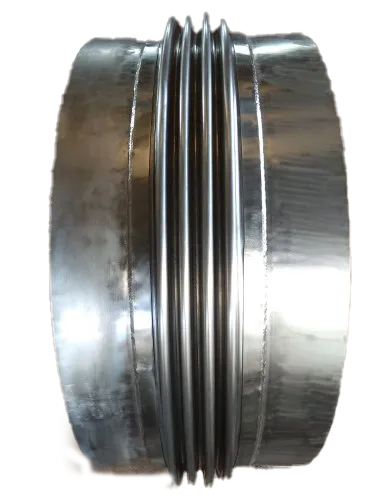
The bellows are the core component of the expansion joint, and their design is crucial. In fixed tube sheet heat exchangers, the bellows should be selected based on the actual working conditions, such as temperature, pressure, and compensation amount. For heat exchangers with large compensation requirements, appropriate wave height and wave distance should be chosen to ensure that the bellows have sufficient compensation capacity under the allowed pressure. The material is usually stainless steel, which balances corrosion resistance, strength, and elasticity.
When designing the bellows, fatigue life should be considered, as they are prone to fatigue failure due to alternating stress during the operation of the heat exchanger. By adopting a reasonable structural design and material selection, the fatigue strength can be improved, and the service life can be extended. At the same time, strict control of the manufacturing process, such as welding quality and forming process, is necessary to ensure the quality and performance of the bellows and the safe operation of the heat exchanger.
Expansion joints also include accessories such as end pipes, supports, flanges, and guide pipes, which together with the bellows form an integrated structure to ensure stable and reliable operation, directly affecting the performance of the heat exchanger.
End pipes connect the bellows to the heat exchanger pipes or equipment and must ensure a secure and sealed connection. Supports hold the bellows to prevent excessive deformation and damage during the operation of the heat exchanger. Flanges connect the expansion joint to the heat exchanger pipes or equipment, and their design must comply with standard specifications to ensure a reliable and sealed connection. Guide pipes direct the flow of fluid, reducing the impact and wear on the bellows, and their design should take into account the fluid properties and the structure of the bellows.
When designing accessories, the interaction with the bellows should be considered. For example, the position and structure of the supports affect the deformation characteristics of the bellows, and the shape and size of the guide pipes affect the fluid flow and the forces on the bellows. The design of accessories should be closely coordinated with the design of the bellows, with an overall optimization to improve the performance and reliability of the expansion joint and ensure the normal operation of the heat exchanger.
The overall structural design of the expansion joint should consider requirements for installation, operation, and maintenance, especially in fixed tube sheet heat exchangers. The installation position and direction should be reasonably designed to maximize the compensation and vibration reduction functions and facilitate installation and maintenance. During the design process, the connection between the expansion joint and other equipment and pipelines of the heat exchanger should be considered to ensure the overall system's consistency.
To ensure the safe operation of the expansion joint in the heat exchanger, protective devices should be installed. For example, protective tie rods or rings can be placed at both ends of the bellows to prevent damage from over-compensation; guide supports can be installed on the connecting pipes to guide the direction of displacement, reduce lateral forces, and extend the service life of the expansion joint, ensuring the long-term stable operation of the heat exchanger.
The problem of thermal stress in fixed tube sheet heat exchangers has long been a challenge in industrial production, and the advent of expansion joints has provided an effective solution. Through the introduction in this article, we have gained an understanding of the working principles, types and characteristics, and design considerations of expansion joints, as well as observed their good performance in practical applications. In actual engineering, the correct selection and design of expansion joints can effectively enhance the operational performance and safety of fixed tube sheet heat exchangers, providing strong support for industrial production.