

- Mar 09, 2026
- Hits: 65
Stainless steel storage tanks are sealed containers made from stainless steel materials such as 304 and 316L. They are primarily used to store various liquid materials or serve as equipment in production processes. Thanks to their excellent corrosion resistance, reliable sealing performance, and long service life, these tanks play an essential role in modern industrial production.
The core functions of stainless steel storage tanks can be summarized in three main aspects. First is the storage function. They can be used to store food-grade liquids such as water, wine, and edible oils, as well as chemical materials such as acids and alkalis. The typical temperature resistance range is from -20°C to 300°C. Second is the process function. In pharmaceutical or chemical production, these tanks can serve as mixing or reaction vessels equipped with heating or cooling jackets to support processes such as fermentation and synthesis. Third is the environmental protection function. Stainless steel storage tanks are widely used to store wastewater or gas-scrubbing liquids. Their corrosion resistance is significantly better than that of carbon steel tanks, and their service life can exceed 15 years. In the food and pharmaceutical industries, tanks that comply with FDA certification are widely used. Their internal surfaces can be polished to a precision of Ra ≤ 0.6 μm, which effectively prevents microbial residue and ensures product safety and quality.
After understanding the basic concept and functions of stainless steel storage tanks, it is necessary to select the appropriate type based on the actual application scenario. Tanks with different structures, materials, and applications have significantly different performance characteristics and suitable operating conditions.
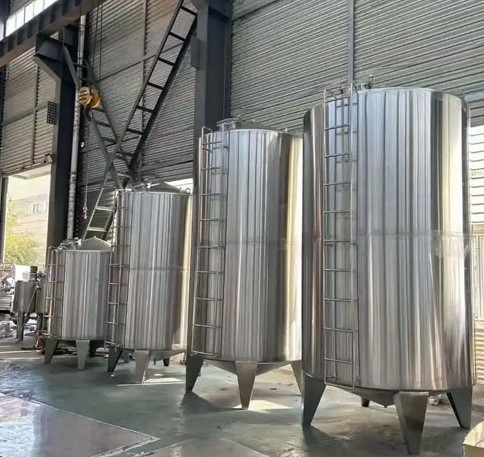
Vertical storage tanks are cylindrical or spherical containers installed vertically. Their greatest advantage is their small footprint, making them particularly suitable for factory environments where space is limited. These tanks typically have capacities ranging from 1 to 100 cubic meters and are widely used in food processing plants. According to the top design, they can be classified into flat-bottom cone-top, dome-top, and other types. The cone-top design usually has a slope angle of 30 degrees or more, which facilitates complete discharge of materials and minimizes residue.
Horizontal storage tanks are installed in a horizontal orientation and provide greater stability, especially in high-pressure environments. Their design pressure is typically ≥0.1 MPa, and they are commonly used for storing petroleum products, liquefied gas, and similar media. These tanks can be equipped with saddles or supporting legs to facilitate transportation and on-site installation, making them widely used in the chemical and energy industries.
304 stainless steel storage tanks are the most common type and are suitable for environments containing mildly corrosive media. This material is widely used in gas engineering, organic chemical production, and hazardous waste treatment industries. Due to its stable chemical properties, it does not easily react with most chemical substances. The inner and outer walls of a 304 stainless steel gas storage tank are clean and free of impurities, providing high purity. The outer surface usually does not require additional anti-corrosion treatment. Compared with carbon steel gas tanks, it does not suffer from corrosion leakage and has lower long-term maintenance costs.
316L stainless steel storage tanks contain molybdenum, making them particularly suitable for environments containing chloride ions, such as seawater treatment and salt-based chemical processes. Under conditions of high chloride concentration or elevated temperatures, 316L exhibits significantly better resistance to pitting corrosion and crevice corrosion than 304 stainless steel. However, it should be noted that 316L is not a universal solution. Under extreme conditions, appropriate structural design and maintenance measures are still required.
According to specific applications, stainless steel storage tanks can be further divided into categories such as brewing tanks, food-grade tanks, pharmaceutical tanks, dairy tanks, chemical tanks, petroleum tanks, building material tanks, power industry tanks, and metallurgical tanks.
Based on hygiene standards, they can be classified into sanitary-grade tanks and general-purpose tanks. Based on pressure ratings, they can be divided into pressure vessels and non-pressure vessels.
- Excellent Corrosion Resistance: One of the most outstanding characteristics of stainless steel storage tanks is their corrosion resistance. Materials such as 304 and 316L possess stable chemical properties and are resistant to corrosion from atmospheric exposure and residual chlorine in water. In chemical environments, they can resist a wide range of acidic and alkaline media. Each tank undergoes strict pressure testing and inspection before leaving the factory. Under normal pressure conditions, their service life can exceed 100 years, far longer than the approximately 15-year lifespan of carbon steel tanks.
- Superior Sealing Performance: The sealed design is a key feature of stainless steel storage tanks. It effectively prevents airborne dust, harmful substances, and insects from entering the tank, ensuring that the stored medium remains uncontaminated. For drinking water storage, this design prevents the growth of red worms; for food materials, it prevents microbial contamination; and for chemical media, it prevents both the leakage of volatile substances and the intrusion of external impurities.
- Scientific Internal Design: Stainless steel storage tanks incorporate scientifically designed internal flow structures. This prevents sediment at the bottom of the tank from being stirred up by water flow, ensuring natural stratification of domestic and firefighting water supplies. Water discharged from the tank can experience a 48.5% reduction in turbidity, while water pressure is significantly increased, improving the overall performance of water supply systems. Maintenance is also convenient—sediment can be removed by periodically opening the drain valve at the bottom of the tank, and scale only needs to be cleaned once every three years, significantly reducing cleaning costs.
- Lightweight and Aesthetic Design: For example, a 10-cubic-meter stainless steel spherical water storage tank weighs just over 360 kg, which is only 1/38 the weight of a concrete water tank. It also has lower wind load and an attractive appearance. These tanks can even be used in combination with advertising displays and are considered mature environmentally friendly products. Their lightweight characteristics reduce transportation and installation costs while also lowering structural load requirements.
- Easy Cleaning and Low Maintenance: The inner and outer surfaces of stainless steel storage tanks can undergo high-precision polishing, making it difficult for materials to adhere to the surface and preventing contamination of stored materials. The smooth surface also makes cleaning simple and efficient, allowing the interior to remain clean without frequent maintenance. This feature is particularly important in the pharmaceutical and food industries, where it effectively prevents cross-contamination.
- Design Stage: The manufacturing process begins with detailed design based on the customer's specific requirements and operational conditions. The design includes factors such as tank shape (vertical or horizontal), capacity, material selection (304 or 316L), sealing method, and inlet and outlet pipeline layout. Considerations must also include medium characteristics, operating temperature, pressure requirements, and installation environment.
- Material Processing: According to the design drawings, the tank body is first fabricated from stainless steel plates. The thickness and specifications depend on the operational requirements of the tank. The tank cover and bottom are also manufactured from stainless steel plates and connected to the tank body by welding or bolting. Proper material selection is critical, and stainless steel plates must comply with relevant standards and have qualified material certificates.
- Pipeline and Accessory Fabrication: Based on operational requirements, the inlet and outlet pipeline systems are manufactured, including inlet valves, outlet valves, vents, and inspection ports. The quality of these accessories directly affects the tank’s performance and safety, so standard-compliant components must be selected.
- Assembly and Welding: The tank body, cover, bottom, and pipelines are assembled through welding or bolted connections. This stage requires high technical expertise. Welds must be smooth and clean, free from defects such as weld nodules, cracks, or pores. Internal welds must be ground and polished to ensure smooth surfaces without dead corners. The bottom plate should be flat, and manhole openings must be fully welded. Any protruding edges around the openings should be flanged or treated for safety.
- Heat Treatment and Surface Treatment: The tank undergoes heat treatment and surface finishing to enhance performance and corrosion resistance. Processes such as pickling and passivation restore the protective passive layer on the stainless steel surface. For sanitary-grade tanks, the internal surface roughness must be controlled to Ra ≤ 0.6 μm.
- Quality Inspection: After manufacturing, the tank must undergo comprehensive testing, including hydrostatic tests and airtightness tests, to ensure compliance with design requirements and standards. Each spherical tank undergoes high-strength pressure testing before leaving the factory to ensure safety and reliability.
- Understand the Characteristics of the Stored Medium: Before selecting a tank, it is essential to understand the properties of the stored medium, including its composition, chloride ion concentration, operating temperature, whether the tank will remain idle for long periods, and the type and frequency of cleaning agents used. Chloride ions in water, cleaning agents, or process fluids may increase the risk of pitting and crevice corrosion, especially at higher temperatures.
- Select the Appropriate Material: 304 stainless steel performs well in many general industrial media and offers good economic efficiency for most standard applications. 316L stainless steel, due to its molybdenum content, offers better resistance to chloride-related pitting and crevice corrosion, especially in salty or high-temperature environments. However, even 316L can fail if chloride concentration or temperature exceeds acceptable limits.
- Focus on Structural Design: Crevices and dead zones are the most common corrosion risks in stainless steel tanks. Gasket compression areas, flange connections, weld undercuts, and overlapping internal components are typical risk points. Poor drainage can cause residual liquids to accumulate, increasing corrosion risks. Therefore, factors such as bottom slope, drain location, nozzle extension, weld finishing, and grinding should be carefully considered.
- Pay Attention to Welding Quality: Changes in the heat-affected zone and surface contamination during welding can reduce corrosion resistance and become corrosion initiation points. Proper welding procedure qualification, filler material matching, heat input control, and pickling/passivation treatments are necessary to restore corrosion resistance.
- Food and Beverage Industry: Stainless steel storage tanks are widely used to store water, alcoholic beverages, edible oils, dairy products, and beverages. Tanks that meet FDA standards ensure strict hygiene requirements, while polished internal surfaces prevent microbial contamination.
- Pharmaceutical Industry: The pharmaceutical industry requires extremely high sanitary standards. Stainless steel tanks are used to store raw materials, intermediates, and finished pharmaceutical products. Tanks with heating or cooling jackets allow precise temperature control for fermentation and synthesis processes.
- Chemical Industry: In chemical production, stainless steel storage tanks store acids, alkalis, and organic solvents. 316L stainless steel performs particularly well in chloride-containing environments. When used as reaction vessels, tanks can be equipped with agitators and temperature control systems.
- Environmental Protection: In environmental engineering, stainless steel storage tanks store wastewater and gas-scrubbing liquids. Their corrosion resistance and long lifespan reduce equipment replacement frequency and environmental risks.
- Energy and Metallurgy: Horizontal stainless steel storage tanks are widely used for storing petroleum and liquefied gas due to their ability to withstand higher pressures. In metallurgical industries, they store various process liquids and can operate under high temperatures.
- Regular Inspection: During operation, the tank’s appearance, sealing performance, and valve accessories should be inspected regularly. Welds, connections, and insulation layers should be checked for corrosion or damage.
- Cleaning and Drainage: The tank should be cleaned periodically according to operational conditions. Sediment can be removed through the bottom drain valve, and scale should be thoroughly cleaned approximately every three years.
- Passivation Treatment: If surface contamination or damage to the passive layer occurs, pickling and passivation should be carried out promptly to restore corrosion resistance.
- Protection During Shutdown: For tanks that will remain out of service for long periods, the internal liquid should be drained, and the tank should be kept dry and well ventilated. Before restarting operation, a comprehensive inspection and cleaning should be performed.
As an essential storage device in modern industrial production, stainless steel storage tanks offer outstanding corrosion resistance, excellent sealing performance, scientifically designed internal structures, and long service life. They play an indispensable role in industries such as food processing, pharmaceuticals, chemicals, and environmental protection.
Proper selection, standardized manufacturing, and reasonable maintenance are the key factors for ensuring the long-term stable operation of stainless steel storage tanks. With the continuous advancement of industrial technology and increasing environmental requirements, the application prospects of stainless steel storage tanks will become even broader, providing reliable support for safe production and environmental protection across multiple industries.
