

- Mar 02, 2026
- Hits: 500
In the field of water treatment, multi-media filters are widely used and technologically mature purification equipment. Through the scientific configuration of different types of filter media, they achieve layered interception and deep purification of various impurities in water. However, many users are often confused in practical operation about the order of media addition and the selection criteria. This article will systematically explain the principles of media sequence in multi-media filters, specific operational steps, and important precautions, helping readers comprehensively master this core technology.
The core design concept of a multi-media filter is to utilize filter media with different densities, particle sizes, and functions to construct a gradient filtration system from top to bottom. This design follows the basic principle of “coarse first, then fine; light first, then heavy,” ensuring that when water flows through the filter, impurities of different sizes can be removed step by step.
When raw water enters from the top of the filter, it first comes into contact with the upper layer of coarse-particle media. This layer is mainly responsible for intercepting large suspended solids visible to the naked eye in the water, such as sediment, algae, and floating matter. Subsequently, the water flows into the middle layer of media, where the medium-sized particles capture finer particles, including some organic matter and colloidal substances. Finally, the water passes through the bottom layer of fine-particle media to complete the final fine filtration process, removing those tiny impurities that escaped the first two layers.
The advantage of this layered filtration lies in the fact that each layer of media can perform its specific function, avoiding the problem of premature saturation and clogging of a single medium, while achieving deep purification of water quality. At the same time, a reasonable media configuration can extend the service life of the entire filtration system and reduce operating costs.
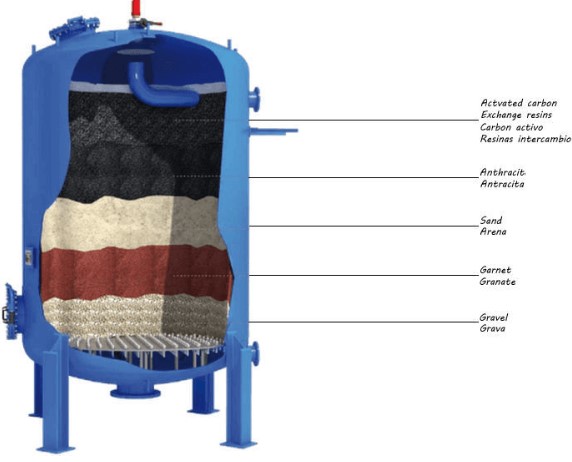
In the design and operation of multi-media filters, the rationality of the media sequence directly determines the quality of filtration performance and the service life of the equipment. A scientific layered configuration not only achieves gradient purification of water quality but also ensures effective re-stratification after backwashing, maintaining long-term stable operation of the system. The following provides a detailed analysis of the standard three-layer media configuration and its functional positioning, helping to understand the specific role and cooperative relationship of each layer within the entire filtration system.
Anthracite is the standard configuration medium for the top layer of a multi-media filter. This medium is characterized by low density and high porosity, with a typical particle density between 1.4 and 1.6 g/cm³, which is much lower than other common filter media.
The main function of anthracite is preliminary coarse screening, intercepting larger suspended solids in the water, including sand particles, algae, floating organic fragments, and similar materials. Due to its lighter texture and larger void spaces, head loss is relatively small, and even when treating high-turbidity raw water, it does not clog rapidly. In addition, anthracite has extremely strong chemical stability. Under normal water treatment conditions, it does not easily react chemically with substances in the water. It is wear-resistant and has a relatively long service life, generally reaching 3–5 years.
In practical applications, the filling height of anthracite is usually around 400 mm. The particle size is typically selected within the range of 0.8–1.8 mm. This size range ensures effective interception capability while also allowing smooth fluidization during backwashing, facilitating the detachment of impurities.
Quartz sand is the backbone of the multi-media filter and one of the most widely used filter materials. Its main component is silicon dioxide, with a hardness of 7 on the Mohs scale, giving it extremely strong abrasion resistance.
The density of quartz sand is approximately 2.65 g/cm³, significantly higher than that of anthracite. In standard configurations, the quartz sand layer is usually divided into two parts: the lower part is a supporting layer of about 200 mm, using larger particles (2–4 mm) to support the upper layer; the upper part is a filtration layer of about 600 mm, using medium-sized particles (0.5–1.2 mm) for fine filtration.
The core function of quartz sand is to intercept medium-sized impurities, including fine dust, some organic particles, and colloidal substances. Due to its controllable particle uniformity, it provides relatively high filtration precision. At the same time, the large specific surface area of quartz sand gives it a certain adsorption capacity, enabling it to adsorb some ions and micro-colloids in the water, further improving the degree of purification.
In terms of filling sequence, quartz sand is positioned beneath anthracite, which conforms to the principle of “coarse above and fine below, light above and heavy below.” After backwashing, the denser quartz sand naturally settles in the lower layer, forming a clear boundary with the anthracite above.
In the standard three-layer media configuration, the bottom layer usually consists of magnetite or garnet and other high-density filter media. Magnetite has a density as high as 4.5–5.0 g/cm³, making it the heaviest among commonly used filter media.
The primary function of magnetite filter media is fine filtration and the removal of special impurities. Due to its higher density and magnetic properties, it has excellent capture capability for fine and heavy particles, including micro iron filings suspended in water and certain heavy metal ions. Magnetite can efficiently remove residual fine impurities in water, ensuring the final clarity of the effluent.
The filling height of the magnetite layer is generally about 200–300 mm, with a particle size of 0.25–0.5 mm. Although this layer is not very thick, it plays a critical role as a supplement and safeguard to the filtration provided by the upper two layers.
Beneath all functional filter media, a support layer must be laid, typically composed of pebbles or gravel. The main purpose of this layer is to support the upper filter media and prevent them from being dispersed by water flow or lost from the bottom during filtration.
The support layer is usually divided into four specifications, laid in the order of “from bottom to top, large first then small.” The bottommost layer uses large pebbles of 32–64 mm, followed upward by 16–32 mm, 8–16 mm, and 4–8 mm pebbles, with a total height of about 300–400 mm. This gradation method ensures sufficient support strength while forming a stable pore structure, allowing filtered clean water to pass smoothly and enabling water and air to flow effectively during backwashing.
Although the standard three-layer media configuration is suitable for most conventional water qualities, when treating special water conditions, the types and sequence of filter media need to be adjusted according to specific circumstances.
When the iron content in raw water is high, a manganese sand layer can be added above the quartz sand layer. The main component of manganese sand is manganese dioxide, which has a catalytic oxidation effect. It can oxidize ferrous iron in water into ferric iron and form ferric hydroxide precipitates, thereby achieving iron removal.
In this configuration, the media sequence from top to bottom is usually: anthracite — manganese sand — quartz sand — magnetite. The filling height of manganese sand is generally 400–600 mm, with a particle size of 0.6–1.2 mm. It should be noted that manganese sand requires periodic regeneration, usually by soaking in a potassium permanganate solution to restore its oxidation capacity.
For drinking water with excessive fluoride content, activated alumina or calcium-silicon filter media can be selected as fluoride removal media. Activated alumina has a strong selective adsorption capacity for fluoride ions and is the most widely used fluoride removal filter material.
When configuring a fluoride-removal multi-media filter, activated alumina is typically used as the main fluoride-removal layer and placed above the quartz sand layer. The media sequence is: anthracite — activated alumina — quartz sand — support layer. The filling height of activated alumina is determined according to the fluoride content in the raw water, generally 800–1200 mm. After adsorption saturation, it can be regenerated using aluminum sulfate or sodium hydroxide solution.
When the raw water contains a high level of organic matter, such as in surface water treatment or wastewater reuse scenarios, an activated carbon layer should be added to the media system. Activated carbon has extremely strong adsorption capacity and can effectively remove organic matter, residual chlorine, color, and odor from water.
Since activated carbon has a relatively low density (0.4–0.6 g/cm³), it is usually placed at the top layer, above anthracite or replacing anthracite. The media sequence is: activated carbon — quartz sand — magnetite — support layer. The height of the activated carbon layer is generally 400–600 mm, with a particle size of 1–2 mm. Due to its limited adsorption capacity, activated carbon needs to be replaced periodically, typically every 6–12 months.
Multi-media filters adopt a filling sequence of “from top to bottom, particle size decreasing, density increasing.” This design is supported by rigorous scientific logic and engineering practice.
First, this sequence conforms to the gradient filtration principle. The upper layer with larger pores first contacts the raw water and quickly intercepts large particle impurities, reducing the turbidity of subsequent water flow. If small-particle media were placed on top, large particle impurities would rapidly clog the surface layer, causing a sharp increase in head loss and significantly shortening the filtration cycle.
Second, density stratification ensures automatic re-layering after backwashing. During backwashing, the media layer is fluidized, and particles collide and rub against each other, removing surface impurities. After flushing ends, denser particles naturally settle in the lower layer, while lighter particles float above, automatically restoring the original stratification. If the density order were reversed, mixing would occur after backwashing, damaging filtration performance.
Third, this configuration allows full utilization of each medium’s advantages. Anthracite performs coarse filtration with low head loss; quartz sand provides medium filtration with moderate precision; magnetite completes fine filtration to ensure effluent quality. Each layer has a clear division of labor and works collaboratively to maximize overall filtration efficiency.
After clarifying the standard media sequence and functional positioning, the selection of filter media and filling process in actual operation are equally critical. Even if the correct sequence is followed, neglecting media performance parameters, particle size matching, and filling specifications will make it difficult to achieve ideal filtration results.
The particle size of filter media should comprehensively consider water quality characteristics, filtration precision, and operating costs. If the particle size is too large, fine suspended solids may penetrate the filter layer, leading to substandard effluent quality. If the particle size is too small, although filtration precision improves, impurities will concentrate locally within the filter layer, accelerating clogging, increasing flow resistance, raising energy consumption, and shortening the filtration cycle.
At the same time, the non-uniformity of media significantly affects equipment operation. If the particle size distribution is too wide, backwashing becomes difficult. Therefore, the uniformity coefficient (D60/D10) should generally be controlled below 1.4.
Filter media must have sufficient chemical stability to resist corrosion from water quality. They should not contain substances harmful to human health or materials that affect subsequent processes or product quality. For example, in food industry water treatment, media must meet food-grade standards; in electronic industry ultrapure water preparation, leachables must be extremely low.
Filter media must possess sufficient mechanical strength to withstand hydraulic scouring and particle collision during filtration and backwashing. Media with insufficient strength will rapidly wear and break, leading to reduced particle size and deterioration of uniformity. Generally, the sum of abrasion rate and breakage rate should not exceed 2%.
The filling height should be adjusted according to equipment design and operational requirements. Typically, the total height of functional filter media above the distribution plate is about 1000–1200 mm, and the straight section height of the tank is around 2000 mm. Specifically: anthracite about 400 mm; quartz sand about 800 mm (including 200 mm support layer); magnetite about 200–300 mm; support layer about 300–400 mm.
The media sequence of a multi-media filter is a fundamental and critical technical element in water treatment processes. The standard configuration from top to bottom is anthracite, quartz sand, magnetite (or other heavy media), and a pebble support layer. This sequence follows the principle of “coarse above, fine below; light above, heavy below,” ensuring effective filtration and automatic stratification after backwashing.
In practical applications, the types and configuration of media should be flexibly adjusted according to raw water quality and treatment objectives. Iron-containing water requires a manganese sand layer; fluoride-containing water requires activated alumina or calcium-silicon media; high-organic water requires activated carbon. Regardless of configuration, filter media must have good chemical stability, mechanical strength, appropriate particle size selection, and filling heights that meet design requirements.
Only with the correct media sequence combined with standardized operation and maintenance can a multi-media filter achieve optimal performance, providing safe and reliable water quality assurance for industrial production and residential life. Mastering these technical points offers important guidance for the selection, installation, operation, and maintenance of water treatment equipment.
