An air receiver tank is an important component of a compressed air system. It stores compressed air, smooths pressure fluctuations, reduces the frequency of compressor loading and unloading, and provides a temporary reserve of compressed air when demand changes rapidly. Although an air receiver is designed to operate within a specified pressure range, excessive pressure is a serious abnormal condition that should never be ignored.
When the pressure inside an air receiver rises above its intended operating range, the problem is rarely caused by the tank itself. In most cases, excessive pressure is related to the interaction between the compressor, unloading system, inlet valve, pressure control components, discharge system, safety devices, and actual compressed-air demand. A control component that fails to respond correctly can allow the compressor to continue supplying air even after the receiver has reached the intended unloading pressure.
The consequences can extend beyond increased energy consumption. Excessive pressure increases mechanical stress on the pressure vessel and piping system, may accelerate component wear, and can create a serious safety hazard if pressure protection devices do not function correctly.
For this reason, diagnosing high air receiver pressure requires more than simply adjusting one pressure setting. Operators should understand how the compressor and receiver work together, verify the unloading sequence, inspect the inlet and discharge control components, and confirm that pressure protection devices are correctly selected, installed, and maintained.
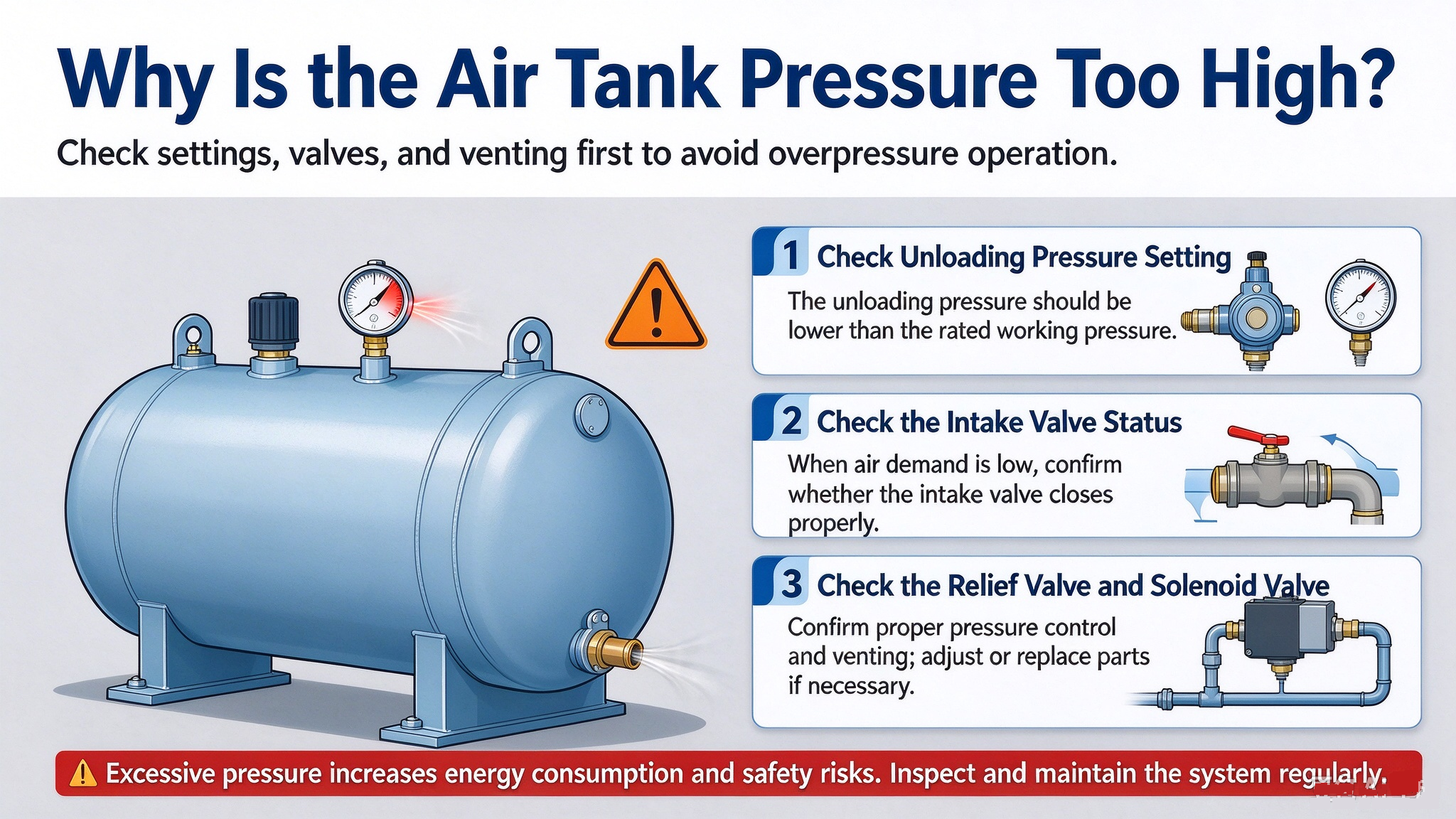
An air receiver tank, also known as a compressed air receiver or air storage tank, is a pressure vessel used to store compressed air between the compressor and downstream demand.
The tank serves several important functions within an industrial compressed-air system. First, it provides a buffer between compressor output and fluctuating air consumption. Instead of requiring the compressor to respond instantly to every change in demand, the receiver can temporarily supply stored air during short periods of increased consumption.
Second, the receiver helps stabilize system pressure. Compressor discharge flow is not always perfectly synchronized with downstream demand, especially in systems containing reciprocating compressors or variable production loads. The receiver provides additional volume that reduces rapid pressure fluctuations.
Third, a properly sized receiver can reduce unnecessary compressor cycling. When the system reaches the upper pressure limit, the compressor can unload or reduce output. During periods of demand, stored compressed air can support the system before the compressor needs to return to full loading.
However, the receiver is still a pressure vessel. It must therefore operate within its rated design and working conditions.
Excessive pressure usually occurs when compressed air continues entering the receiver after the system should have unloaded or reduced compressor output.
The basic pressure balance can be understood conceptually as:
Air entering the receiver > Air leaving the receiver
If the compressor continues supplying air while downstream consumption is low, receiver pressure will continue to rise.
Under normal operation, the control system should prevent this situation by unloading the compressor, closing or modulating the inlet valve, changing compressor capacity, or otherwise reducing compressed-air production.
Therefore, excessive pressure often indicates a problem with pressure control, unloading logic, inlet control, discharge control, sensing, or safety protection.
Common causes include:
- Incorrect unloading pressure settings.
- Incorrect pressure switch settings.
- Faulty pressure sensors.
- Inlet valves that fail to close or modulate.
- Malfunctioning solenoid valves.
- Discharge or exhaust valves that do not operate correctly.
- Blocked or restricted control lines.
- Compressor control-system faults.
- Incorrect pressure measurement.
- Sudden reduction in compressed-air demand.
- Incorrect installation or adjustment of control components.
- Faulty or incorrectly selected pressure relief devices.
Each of these conditions should be evaluated systematically.
One of the first items to check when an air receiver experiences excessive pressure is the compressor's unloading pressure.
A compressor normally operates between defined pressure limits. When system pressure reaches the upper control point, the compressor should unload, stop, reduce capacity, or otherwise stop adding compressed air to the receiver.
If the unloading pressure is incorrectly configured above the intended operating range, the receiver can continue accumulating compressed air until the control system finally responds.
The unloading setting must be coordinated with:
- Compressor rated pressure
- Receiver design pressure
- System operating pressure
- Pressure switch range
- Downstream equipment requirements
- Safety valve setting
- Compressor manufacturer's specifications
It is important to distinguish the normal operating pressure, unloading pressure, and maximum allowable working pressure. These values should not be treated as interchangeable.
The unloading pressure should remain within the permissible operating range established by the system design and compressor manufacturer.
Many compressed-air systems use a pressure switch to control compressor loading and unloading.
The pressure switch monitors system pressure and sends a control signal when the pressure reaches a defined set point. If the pressure switch is incorrectly adjusted, mechanically damaged, contaminated, or electrically defective, the compressor may not unload at the intended pressure.
A pressure switch may develop problems such as:
- Incorrect cut-in setting
- Incorrect cut-out setting
- Contact welding
- Electrical contact failure
- Diaphragm damage
- Calibration drift
- Blocked sensing port
- Mechanical wear
If the receiver pressure is consistently higher than expected, technicians should compare the actual pressure measured by a calibrated instrument with the pressure indicated by the control system.
This simple comparison can help determine whether the problem is actually excessive pressure or merely inaccurate pressure measurement.
Modern compressors frequently use electronic pressure sensors or transmitters instead of purely mechanical pressure switches.
These sensors provide pressure feedback to a controller, which determines when to load, unload, modulate, or stop the compressor.
If the sensor produces an incorrect low-pressure signal while the actual receiver pressure is already high, the controller may continue operating the compressor.
For example, the actual receiver pressure might be significantly higher than the value displayed by the controller. If the controller believes the pressure remains below the unloading point, it may continue requesting compressed-air production.
Sensor-related problems can include:
- Calibration drift
- Electrical connection failure
- Signal interference
- Damaged sensing elements
- Blocked pressure connections
- Incorrect sensor range
- Controller configuration errors
A calibrated independent pressure gauge is therefore extremely useful during troubleshooting.
The compressor's inlet valve is another major component to inspect.
In many compressor designs, the inlet valve regulates the amount of air entering the compression chamber. During unloading, the control system should reduce or stop the compressor's ability to draw and compress atmospheric air.
If the inlet valve remains partially or fully open when it should close, the compressor may continue producing compressed air.
Potential causes include:
- Valve actuator failure
- Damaged diaphragm
- Contamination
- Weak spring
- Control-air problem
- Mechanical sticking
- Solenoid malfunction
- Incorrect adjustment
The inlet valve should therefore be inspected whenever the compressor appears to continue loading after reaching its intended unloading pressure.
Solenoid valves are often used to control pneumatic or hydraulic signals associated with compressor loading, unloading, inlet valves, blowdown systems, and other control functions.
A failed solenoid valve may prevent the correct control signal from reaching the relevant actuator.
For example, if a solenoid valve responsible for unloading remains in the wrong position, the compressor may continue operating under load.
Common solenoid problems include:
- Coil failure
- Burned electrical winding
- Sticking spool
- Contaminated valve body
- Incorrect voltage
- Loose wiring
- Damaged seals
- Incorrect installation
Because the solenoid valve is often a relatively small component controlling a much larger mechanical process, its failure can have a significant impact on receiver pressure.
The discharge or exhaust system must also be checked when investigating abnormal pressure.
Depending on the compressor configuration, unloading may involve releasing pressure from specific parts of the compressor rather than simply stopping motor rotation.
If the discharge or blowdown valve does not operate correctly, pressure may remain trapped in the wrong section of the system.
A valve that is stuck closed, partially blocked, or incorrectly controlled may interfere with the intended unloading sequence.
Technicians should therefore inspect the complete unloading circuit rather than replacing only the pressure switch or sensor.
Not every high-pressure condition is caused by a component failure.
A significant reduction in compressed-air consumption can also cause receiver pressure to rise rapidly.
For example, a manufacturing plant may normally consume large quantities of compressed air during production. If several production lines stop simultaneously during a shift change, weekend shutdown, or process interruption, demand can suddenly fall.
If the compressor continues producing air at the same rate, the receiver pressure will increase until the compressor unloads.
This is a particularly important consideration in systems with oversized compressors.
The problem may therefore be operational rather than mechanical.
An oversized compressor can contribute to unstable pressure control.
If the compressor produces substantially more air than the facility normally consumes, the system may spend much of its operating time unloading and reloading.
Frequent cycling can increase energy consumption and mechanical wear.
In extreme cases, a poorly configured control system may struggle to respond smoothly to rapidly changing demand.
A properly designed compressed-air system should therefore consider the actual consumption profile rather than simply selecting the largest available compressor.
Receiver capacity influences how quickly system pressure changes.
A larger receiver provides more stored air and can reduce pressure fluctuations during short-term demand changes. However, a larger tank does not automatically solve a control problem.
If the compressor fails to unload at the correct pressure, increasing receiver volume only increases the amount of compressed air that can accumulate before the pressure reaches the safety limit.
Therefore, tank sizing and compressor control must be considered together.
Important design factors include:
- Compressor capacity
- Average air demand
- Peak air demand
- Demand fluctuations
- Required pressure stability
- Compressor control method
- Receiver location
- Downstream process requirements
One of the most important concepts in air receiver safety is the distinction between normal operating pressure and the vessel's rated pressure.
The receiver should operate within its specified pressure limits. The maximum allowable working pressure is a design and safety parameter associated with the pressure vessel and applicable regulations or standards.
Normal operating pressure should generally remain below the maximum allowable working pressure with an appropriate engineering margin.
The exact limits depend on the specific vessel design, certification, applicable jurisdiction, temperature, materials, and manufacturer's documentation.
Operators should never increase the pressure setting simply because the vessel appears physically capable of handling more pressure.
A properly selected and maintained pressure relief valve is a critical safety component on a compressed-air receiver.
Its purpose is to prevent pressure from exceeding the permitted limit under abnormal conditions.
The relief valve should be correctly sized, properly installed, and maintained according to the applicable pressure-vessel requirements and manufacturer instructions.
A relief valve should not be used as a normal pressure-control device.
If the safety valve repeatedly lifts during normal compressor operation, this is an indication that the primary control system requires investigation.
Repeated relief-valve operation may cause:
- Energy loss
- Noise
- Component wear
- Pressure instability
- Premature valve damage
- Increased operational risk
The correct response is to identify why pressure control has failed rather than simply increasing the relief setting.
Excessive compressed-air pressure can directly increase energy consumption.
Compressing air to a higher pressure requires more compressor work. If the plant does not actually require the additional pressure, the excess pressure represents unnecessary energy consumption.
This is particularly relevant in large industrial compressed-air systems that operate continuously.
For example, if downstream equipment requires a certain pressure but the compressor system is maintained significantly above that requirement, the compressor may consume additional energy without delivering corresponding production benefits.
Pressure optimization should therefore be considered part of an overall compressed-air energy-efficiency strategy.
Industrial operators sometimes increase compressor pressure to compensate for pressure drops in piping, filters, dryers, regulators, or other components.
This approach can create a cycle:
Pressure drop → Increase compressor pressure → Higher energy consumption → Higher system stress
A better solution is often to identify the actual source of pressure loss.
Potential causes include:
- Undersized piping
- Dirty filters
- Excessively long pipelines
- Incorrect fittings
- Partially closed valves
- Water accumulation
- Poorly designed distribution networks
- Excessive local demand
The goal should be to deliver the required pressure to the point of use rather than simply increasing the receiver pressure.
Leaks are another major factor in compressed-air systems, although they generally cause pressure loss rather than directly causing excessive receiver pressure.
If a system has significant leakage, the compressor may operate more frequently to maintain pressure.
When leaks are repaired or production demand suddenly falls, the compressor may reach its unloading pressure much more quickly.
This illustrates why pressure behavior should always be analyzed together with system demand.
Regular leak detection can improve both energy efficiency and pressure stability.
A check valve is commonly installed in compressed-air systems to prevent reverse flow.
If a check valve fails, compressed air may flow backward into the compressor or another part of the system.
Although this is not always the primary cause of excessive receiver pressure, a malfunctioning check valve can interfere with normal compressor operation and unloading behavior.
The valve should therefore be checked when diagnosing unusual pressure fluctuations or abnormal compressor cycling.
Pressure and temperature are closely related in compressed-air systems.
When air is compressed, its temperature increases. After compression, cooling occurs through aftercoolers, piping, and the receiver.
Changes in temperature can therefore influence measured pressure.
For example, a receiver may show a different pressure after prolonged compressor operation than it does after the system has cooled.
Operators should interpret pressure readings together with temperature conditions and measurement location.
Temperature also matters because pressure-vessel design ratings may be associated with specific temperature conditions. The applicable technical documentation should always be consulted when evaluating operating limits.
Compressed air contains atmospheric moisture. During compression and subsequent cooling, water can condense inside the air receiver.
If condensate is not properly drained, water accumulation can contribute to internal corrosion.
Internal corrosion can gradually reduce vessel integrity and increase the importance of inspection and maintenance.
Automatic or manual drains should therefore be checked regularly.
A receiver drain system should be able to remove condensate without compromising the pressure boundary.
Because an air receiver is a pressure vessel, maintenance should go beyond simply checking the pressure gauge.
A comprehensive inspection program may include:
- Checking external corrosion.
- Inspecting weld areas.
- Checking pressure gauges.
- Testing pressure relief devices.
- Inspecting inlet and outlet connections.
- Checking drain valves.
- Inspecting control valves.
- Verifying pressure sensors.
- Checking for abnormal vibration.
- Reviewing operating pressure records.
- Inspecting internal condition when required.
- Maintaining inspection and certification records.
The exact inspection frequency and requirements depend on the applicable regulations, vessel classification, jurisdiction, service conditions, and manufacturer's instructions.
When an air receiver pressure rises unexpectedly, technicians should avoid randomly adjusting multiple components at the same time.
A systematic procedure is more effective.
Compare the control-system reading with a properly calibrated pressure gauge.
If the two values differ significantly, investigate the measurement system before changing compressor settings.
Verify the compressor's loading and unloading pressure settings against the manufacturer's specifications and system design.
Determine whether the compressor actually unloads when the receiver reaches the upper pressure set point.
If it continues loading, investigate the control circuit.
Verify whether the inlet valve closes or modulates as required during unloading.
Inspect electrical signals, coil condition, pneumatic control pressure, wiring, and valve movement.
Confirm that unloading and pressure-release components operate correctly.
Determine whether the plant's compressed-air demand has unexpectedly decreased.
Confirm that the pressure relief device is correctly selected, installed, and maintained.
Do not adjust or disable a safety device simply to prevent it from opening.
Check the tank for corrosion, leakage, deformation, abnormal noise, or other signs of deterioration.
Document pressure, temperature, compressor status, demand, valve position, and control signals. Trend data can help identify intermittent faults that are difficult to detect during a single inspection.
Several common practices can create additional risk.
Increasing the pressure setting without determining why pressure is already excessive can move the system closer to its design limit.
A safety valve is not a pressure-control device. Unauthorized adjustment or obstruction can compromise the vessel's protection system.
Replacing a pressure switch or solenoid valve without verifying the actual fault may not solve the problem.
A faulty gauge or sensor can lead technicians to diagnose a problem that does not actually exist.
The receiver is only one part of the compressed-air system. Compressor controls, valves, piping, demand, and safety devices must all be considered.
Selecting a suitable air receiver is essential for safe and efficient compressed-air operation.
Important parameters include:
| Parameter | Selection Consideration |
|---|---|
| Volume | Based on compressor capacity and demand profile |
| Working pressure | Must meet system requirements |
| Design pressure | Must satisfy applicable vessel requirements |
| Temperature | Must match operating conditions |
| Material | Must suit the service environment |
| Corrosion protection | Important for long-term durability |
| Connections | Must match system piping |
| Drain system | Required for condensate management |
| Pressure gauge | Must provide appropriate measurement range |
| Relief valve | Must provide suitable overpressure protection |
| Certification | Must comply with applicable regulations |
A reputable manufacturer should provide appropriate technical documentation, pressure-vessel information, inspection records, and operating instructions.
A safe compressed-air system depends on multiple protection layers rather than a single component.
A practical safety strategy includes:
- Correct pressure settings.
- Reliable compressor controls.
- Properly functioning inlet valves.
- Reliable solenoid valves.
- Accurate pressure measurement.
- Properly selected relief valves.
- Regular condensate drainage.
- Periodic vessel inspection.
- Corrosion management.
- Operator training.
- Preventive maintenance.
- Appropriate emergency procedures.
The system should also be designed so that a single control-component failure does not create an unacceptable pressure hazard.
Pressure management is closely related to energy efficiency.
The objective is not simply to operate the receiver at the highest possible pressure. Instead, the system should provide sufficient pressure for the most demanding legitimate application while minimizing unnecessary compression.
An industrial compressed-air audit can examine:
- Compressor loading profile
- Unloading frequency
- Receiver pressure trend
- Peak demand
- Average demand
- Leakage rate
- Pressure drop
- Dryer and filter losses
- End-use pressure requirements
- Compressor efficiency
This approach can reveal whether excessive pressure is actually a symptom of broader system-design problems.
Excessive air receiver pressure is a condition that requires immediate attention because an air receiver is a pressure vessel operating with stored energy. The root cause may be relatively simple, such as an incorrect unloading setting, but it may also involve a failed pressure sensor, malfunctioning inlet valve, defective solenoid valve, control-system problem, reduced air demand, or inadequate maintenance.
The first step is to verify the actual pressure using reliable measurement equipment. Operators should then check the compressor's unloading pressure, inlet valve, solenoid valve, discharge system, pressure-control circuit, and actual air demand. The pressure relief system must also be verified as an independent layer of protection.
A well-designed air receiver system should maintain pressure within the intended operating range without relying on the safety valve for routine control. Correct vessel selection, appropriate compressor sizing, reliable control components, regular condensate drainage, corrosion inspection, and preventive maintenance all contribute to safe and efficient operation.
For industrial users, choosing a qualified air receiver manufacturer and maintaining the vessel according to applicable pressure-vessel requirements are equally important. A high-quality tank cannot compensate for poor system control, and an advanced compressor cannot eliminate the need for pressure-vessel inspection.
Ultimately, preventing excessive air receiver pressure requires a system-level approach. By coordinating compressor capacity, unloading pressure, inlet and discharge control, pressure measurement, safety devices, air demand, and maintenance, operators can reduce energy waste while protecting equipment and personnel from the potentially serious consequences of overpressure.