In the field of industrial production, large vertical storage tanks play an indispensable role, bearing the responsibility of storing liquids or gases. The installation process of these massive structures is complex and precise, directly affecting the safety and efficiency of their subsequent use. Today, let us explore the two main installation methods of large vertical storage tanks, the erection method and the inversion method, and examine their characteristics, application scenarios, and construction details.
The erection method, as the name implies, starts from the bottom of the tank and builds upwards layer by layer, like stacking building blocks. This method is more common among foreign construction companies, and domestic enterprises also use it in certain special dome-top tank installations. Its construction principle is clear: after completing the tank bottom, construction starts from the lowest wall section, proceeding sequentially from bottom to top. The full circle of the wall panels is first assembled and welded to form a cylinder, then welded to the tank bottom with large fillet welds. Subsequently, the second layer of wall panels is installed on top of the first, proceeding layer by layer until the topmost layer is completed.
- Internal Scaffolding Method: This is a common construction method in the erection approach. Workers build supports inside the wall panels and place planks on them to form scaffolding. Meanwhile, a mobile hanging scaffold is constructed on the outside of the tank wall. This scaffolding provides a stable working platform for workers, facilitating the installation and welding of the tank wall. The advantage of the internal scaffolding method is that workers can closely access the inner wall, allowing more precise welding operations and ensuring welding quality.
- External Scaffolding Method: Similar to the internal scaffolding method, but the scaffolding is set up on the outside of the tank wall. This method also provides good working conditions for construction personnel, but operators must pay extra attention to safety to prevent accidents during high-altitude operations.
- Water-Buoy Erection Method: This method fully utilizes the principle of floating. During the process of filling the tank with water, a floating platform is used as an installation and welding platform to replace scaffolding, assisting external hanging baskets in completing the tank construction. The advantage of the water-buoy erection method is that as the water level rises, the floating platform can automatically adjust its height, reducing the work of scaffolding assembly and disassembly, while also lowering construction costs.
The advantages of the erection method are evident. First, it can fully utilize large lifting equipment to increase prefabrication depth. This means that during construction, a large number of wall components can be prefabricated in advance and then quickly installed in place using lifting equipment, greatly improving construction efficiency. Second, the erection method is relatively easy to master, facilitating the promotion of automated welding technology for tanks. With the development of automation, automated welding can improve the stability and consistency of weld quality, reducing potential errors from manual welding.
However, the erection method also has limitations. It requires a relatively large construction site because a large number of prefabricated components and lifting equipment must be placed. In addition, the technical difficulty is high, with many high-altitude operations posing certain safety risks. During installation, workers need to perform welding and installation at height, and any accident could have severe consequences.
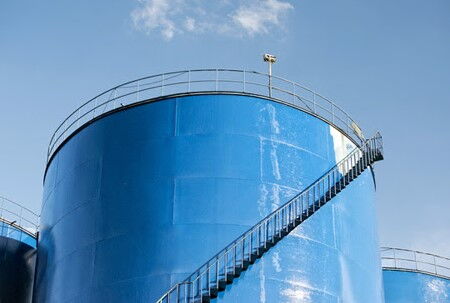
Unlike the erection method, the inversion method assembles the tank from the top downward. This method is widely used in domestic enterprises, especially in dome-top tank installation. Its construction principle is as follows: after the tank bottom is completed, the topmost wall panels are installed first, and only limited positioning is provided at the tank bottom without connecting to it. Hydraulic lifting devices are evenly arranged inside the tank to lift the top wall panels using auxiliary devices such as expansion rings. Then, the next lower wall panels are assembled and welded, welding the vertical seams of the lower panel and the circumferential seams between the top and lower panels. This process repeats until the first circle of wall panels is assembled, followed by welding the large fillet welds between the wall and the tank bottom.
- Hydraulic Lifting Method: This is a relatively advanced inversion method. It uses hydraulic lifting equipment to first weld the topmost wall panel, then lift it, followed by assembly and welding of the second layer. The process continues sequentially until the bottom wall panels are assembled and welded. The advantage of the hydraulic lifting method is the high stability of hydraulic equipment, which can precisely control lifting height and speed, ensuring smooth construction.
- Rod-Lifting Inversion Method: This method uses lifting rods and a hoisting frame to assemble the tank from top to bottom. It is suitable for sites with limited space or where hydraulic equipment cannot be used. Through the lifting effect of the rods, wall panels are installed layer by layer. However, assembling and dismantling the rods is relatively complex and requires significant time and manpower.
- Air Inflation Lifting Method: This is a relatively unique inversion method that uses a blower to input compressed air into the tank to lift the structure. By controlling air pressure, the tank gradually rises, completing wall panel assembly and welding. Its advantage is that the equipment is relatively simple and operation is convenient, but strict control of air pressure is necessary to prevent deformation or failed lifting.
- Mechanical Lifting Method: This method uses multiple electric hoists, starting from the topmost wall panel, lifting and welding each panel in sequence. The equipment cost is relatively low, and operation is simple. However, multiple hoists must work in coordination; otherwise, uneven stress may affect wall panels and construction quality.
The advantage of the inversion method is that it can effectively reduce the risks of high-altitude work. Since assembly starts from the top, workers mostly operate at lower positions, lowering the risk of falling. In addition, the inversion method requires less construction space, unlike the erection method, which needs space for prefabricated components and lifting equipment.
However, the inversion method also has limitations. Because assembly is top-down, each layer requires lifting, making the process relatively complex and demanding high-performance and reliable lifting equipment. Equipment failure may delay the entire construction. Moreover, the method requires frequent alternation between welding and lifting, demanding high technical skill and coordination from workers.
Whether using the erection or inversion method, installation of large vertical storage tanks requires thorough preparation, including design and construction planning, site preparation, and foundation construction.
Designers must determine correct tank dimensions, materials, and structure based on usage requirements and site conditions. This step is crucial because tank design directly affects performance and safety. The design must comply with relevant standards while considering construction feasibility and cost. After design, the construction plan is equally important, detailing every construction step, personnel arrangements, and equipment use. Necessary permits and safety approvals must be obtained.
Site preparation is the foundation for smooth installation. This includes surveying, leveling, and cleaning to ensure a safe and orderly construction environment. Sufficient equipment and personnel should be allocated, with a detailed construction schedule. Equipment selection should match the chosen installation method, ensuring proper performance.
Large vertical tanks require a firm foundation for stability and safety. Foundation construction includes excavation, soil treatment, and concrete pouring. Soil bearing capacity and levelness must be strictly controlled. Soil testing and underground pipeline surveys are necessary to prevent damage during construction. Foundation quality directly affects tank lifespan and safety, and must follow design specifications.
Before tank assembly, the tank must be carefully inspected and cleaned to ensure quality and cleanliness. Even small defects may cause serious problems in later use.
According to the construction plan, cranes, pulleys, or sliding methods are used to install the tank in the designated location. Measurement instruments ensure precise control of position and dimensions, guaranteeing horizontal and vertical alignment. Incorrect leveling may cause uneven stress, affecting tank lifespan. Balance and lifting point selection are crucial to avoid tilting or damage during hoisting.
Tank installation includes connecting inlet and outlet pipelines, welding, fixing, and sealing. Pressure testing and leak detection ensure system integrity. Sealing and insulation are applied to maintain tank tightness and thermal efficiency, using gaskets, sealing tapes, or other materials.
After installation, trial operation and commissioning are required. Trial operation involves filling the tank partially to test stability and safety. Commissioning adjusts control systems, instrumentation, and safety valves. Professional monitoring ensures normal and safe operation. Comprehensive inspections and official acceptance verify installation quality. Additional considerations include solid foundations, proper sealing, vertical pipeline alignment, and protection against sunlight and wind for outdoor tanks. Tanks taller than 10 meters or with length-to-diameter ratio over 5 must account for wind loads.
Installing large vertical storage tanks is a complex and precise task. Both the erection and inversion methods have advantages and limitations. In practice, the choice of method depends on tank type, usage requirements, and site conditions. Regardless of the method, thorough preparation and meticulous attention to every detail of construction are essential to ensure installation quality. Only by doing so can large vertical storage tanks operate safely, stably, and efficiently, providing reliable support for industrial production.
